I. Making music
Chords
A chord is three or more notes sounding together. The chords a song uses come mostly from its key: stack the key's notes in thirds, skipping every other one, from each degree, and you get the seven chords that belong to it. This chapter builds them, names them by number, and shows why one chord moving to the next sounds smooth when its notes move as little as they can. The studio keeps a song's chords on a row of their own, and can play any of them under one finger.
zig build run-studio -- manual/04-chords/triads --view editor
Triads
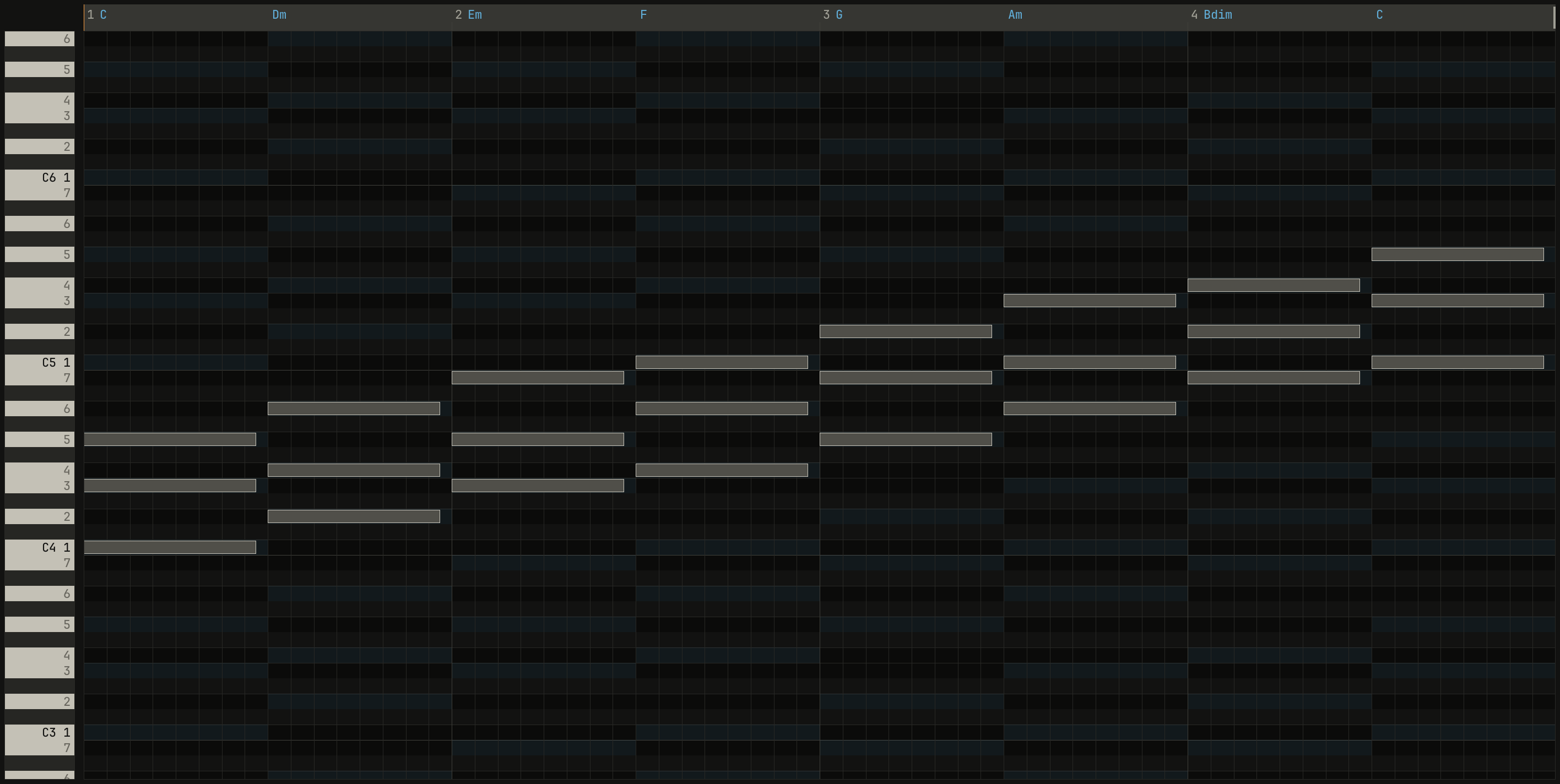
Take every other note of C major from C: C, E, G. That's a triad, a root with a third and a fifth stacked over it, and it's the C major chord. Do the same from each degree and the key gives you seven:
0.0 / 10.0 s
peak -17.2 dBFS
openzig build run-studio -- manual/04-chords/triads --view editor
renderzig build run-studio -- render manual/04-chords/triads triads.wav
triads/song.json
{
  "tempo": 96,
  "end": "5",
  "key": ["1 C major"],
  "chords": ["1 C", "1.3 Dm", "2 Em", "2.3 F", "3 G", "3.3 Am", "4 Bdim", "4.3 C"],
  "devices": [
    { "name": "synth", "type": "synth", "state": { "parts": [{ "patch": "A45", "level": -2, "reverb_send": 15 }] } }
  ],
  "tracks": [
    { "name": "triads", "device": "synth", "channel": 1, "keys": "chord", "role": "chords", "clips": [{ "at": "1", "length": "4.0.0", "notes": "triads" }] }
  ],
  "notes": {
    "triads": {
      "length": "4.0.0",
      "notes": [
        "1.1.0 C4 0.1.840 92", "1.1.0 E4 0.1.840 92", "1.1.0 G4 0.1.840 92",
        "1.3.0 D4 0.1.840 86", "1.3.0 F4 0.1.840 86", "1.3.0 A4 0.1.840 86",
        "2.1.0 E4 0.1.840 92", "2.1.0 G4 0.1.840 92", "2.1.0 B4 0.1.840 92",
        "2.3.0 F4 0.1.840 86", "2.3.0 A4 0.1.840 86", "2.3.0 C5 0.1.840 86",
        "3.1.0 G4 0.1.840 92", "3.1.0 B4 0.1.840 92", "3.1.0 D5 0.1.840 92",
        "3.3.0 A4 0.1.840 86", "3.3.0 C5 0.1.840 86", "3.3.0 E5 0.1.840 86",
        "4.1.0 B4 0.1.840 92", "4.1.0 D5 0.1.840 92", "4.1.0 F5 0.1.840 92",
        "4.3.0 C5 0.1.840 86", "4.3.0 E5 0.1.840 86", "4.3.0 G5 0.1.840 86"
      ]
    }
  }
}
Each chord is three light rows, every other one. They differ in their thirds. C, F, and G have four semitones from the root to the third, a major third, and are major chords. Dm, Em, and Am have three, a minor third, and are minor. B to D is three and D to F three, so the chord on B is diminished, its fifth squeezed a semitone flat. Three major, three minor, one diminished: every major key has the same pattern, and that's why its chords sound like one family.
Numerals
Naming chords by number shows what they do in any key at once. A Roman
numeral names a chord by the degree it's built on, in capitals for a
major chord and small letters for a minor one, with ° for diminished:
| Degree | 1 | 2 | 3 | 4 | 5 | 6 | 7 |
|---|---|---|---|---|---|---|---|
| In C major | C | Dm | Em | F | G | Am | Bdim |
| Numeral | I | ii | iii | IV | V | vi | vii° |
| In A minor | Am | Bdim | C | Dm | Em | F | G |
| Numeral | i | ii° | III | iv | v | VI | VII |
A song in G major has the same numerals over G, Am, Bm, C, D, Em, and
F#dim, so "I V vi IV" is the same progression in every key. Files and
scripts write the marks in ASCII: bVII for ♭VII, and viio for vii°.
Sevenths
Stack one more third and each chord gains its seventh. The seventh chords of a key are richer than its triads, and sit at the heart of jazz, soul, and house:

0.0 / 10.0 s
peak -16.5 dBFS
openzig build run-studio -- manual/04-chords/sevenths
renderzig build run-studio -- render manual/04-chords/sevenths sevenths.wav
sevenths/song.json
{
  "tempo": 96,
  "end": "5",
  "key": ["1 C major"],
  "chords": ["1 Cmaj7", "1.3 Dm7", "2 Em7", "2.3 Fmaj7", "3 G7", "3.3 Am7", "4 Bm7b5", "4.3 Cmaj7"],
  "devices": [
    { "name": "synth", "type": "synth", "state": { "parts": [{ "patch": "A45", "level": -2, "reverb_send": 15 }] } }
  ],
  "tracks": [
    { "name": "sevenths", "device": "synth", "channel": 1, "keys": "chord 7", "role": "chords", "clips": [{ "at": "1", "length": "4.0.0", "notes": "sevenths" }] }
  ],
  "notes": {
    "sevenths": {
      "length": "4.0.0",
      "notes": [
        "1.1.0 C4 0.1.840 92", "1.1.0 E4 0.1.840 92", "1.1.0 G4 0.1.840 92", "1.1.0 B4 0.1.840 92",
        "1.3.0 D4 0.1.840 86", "1.3.0 F4 0.1.840 86", "1.3.0 A4 0.1.840 86", "1.3.0 C5 0.1.840 86",
        "2.1.0 E4 0.1.840 92", "2.1.0 G4 0.1.840 92", "2.1.0 B4 0.1.840 92", "2.1.0 D5 0.1.840 92",
        "2.3.0 F4 0.1.840 86", "2.3.0 A4 0.1.840 86", "2.3.0 C5 0.1.840 86", "2.3.0 E5 0.1.840 86",
        "3.1.0 G4 0.1.840 92", "3.1.0 B4 0.1.840 92", "3.1.0 D5 0.1.840 92", "3.1.0 F5 0.1.840 92",
        "3.3.0 A4 0.1.840 86", "3.3.0 C5 0.1.840 86", "3.3.0 E5 0.1.840 86", "3.3.0 G5 0.1.840 86",
        "4.1.0 B4 0.1.840 92", "4.1.0 D5 0.1.840 92", "4.1.0 F5 0.1.840 92", "4.1.0 A5 0.1.840 92",
        "4.3.0 C5 0.1.840 86", "4.3.0 E5 0.1.840 86", "4.3.0 G5 0.1.840 86", "4.3.0 B5 0.1.840 86"
      ]
    }
  }
}| Chord | Numeral | Kind |
|---|---|---|
| Cmaj7 | Imaj7 | major seventh: a major chord with a major 7th |
| Dm7 | ii7 | minor seventh: a minor chord with a minor 7th |
| Em7 | iii7 | minor seventh |
| Fmaj7 | IVmaj7 | major seventh |
| G7 | V7 | dominant seventh: a major chord with a minor 7th |
| Am7 | vi7 | minor seventh |
| Bm7b5 | viiø7 | half-diminished: a diminished chord with a minor 7th |
Only the chord on 5 is a dominant seventh, and its 3rd and 7th, B and F, are a tritone apart, six semitones, the most restless interval there is. It wants to resolve, B up to C and F down to E: the pull of the leading note from chapter 3, doubled.
The chord row
The row under the sections holds the song's chords, a box each from where it starts to where the next does. A click on a chord selects it and drops the chord list under it:
- In the key: the seven chords, numeral and name, each marked
home,away, ortension, which chapter 5 explains. A›marks those that most often follow the chord before. - Borrowed and dominants: chords from outside the key that songs use
anyway: iv, ♭VI, and ♭VII in a major key, and the dominants that lead
into each degree, such as
V7/vi. - N.C., no chord: the parts that follow the chords rest there.
- Type a chord: any symbol, as
Am7,C/E,Bbmaj7, orF#m7b5.
Up and Down step through the list while the song plays, and each chord sounds on the selected track and plays in the song too, so you hear it in place before you keep it. Enter writes it, and Esc gives the old chord back. The list's chords are triads, sevenths, or ninths as the selected track's way to play asks.
| Mouse on the chord row | Does |
|---|---|
| Click | Selects the chord there, and drops the chord list |
| Double-click | Types a chord, or a chart, from that bar |
| Drag a chord's start | Moves the change, by beats, or by the grid with Ctrl |
| Ctrl-click | Splits the chord at the beat |
| Right-click | Opens the chord's menu, whose remove chord takes the change away |
I ii, beside chords ▾ in the row's header over the track list, shows
numerals on the row in place of names. A chord from outside the key draws
outlined rather than filled, so the row shows where the music leaves home.
The hint over a chord gives its numeral, what it does, and where it usually
goes: vi Am: home, at rest. Usually goes to IV, ii, V. A chord holds
nothing itself. It names what the music is, and the parts that follow it, in
chapter 6, read it.
Chords under one finger
A track's way to play can be chord. Then each white key plays the chord
on its degree, in the easy layout from chapter 3: in C major, the home row
plays C, Dm, Em, F, G, Am, Bdim, and C again. chord 7 plays the sevenths,
chord 9 adds the ninths, and bass sounds the chord's root an octave
under it too. On a track in chord, the MiniLab's pads play the same
degrees, bank A's eight as the white keys of an octave, and bank B's with
the seventh.
The black keys color the chords while they're held:
| Hold | Black key | The chord the white keys play |
|---|---|---|
W |
C# | gains its 7th, or its 9th when sevenths are on |
E |
D# | becomes sus4: the 3rd raised to the 4th |
T |
F# | becomes sus2: the 3rd lowered to the 2nd |
Y |
G# | swaps major and minor: F minor in C major, the parallel key's |
U |
A# | becomes the dominant seventh a fifth above, which leads into it |
So Y with F plays F minor, a borrowed chord, and U with H plays E7,
which pulls into Am. Yamaha's PortaSound keyboards and the Omnichord made
chords from one or two buttons the same way in the early 1980s.
Voice leading
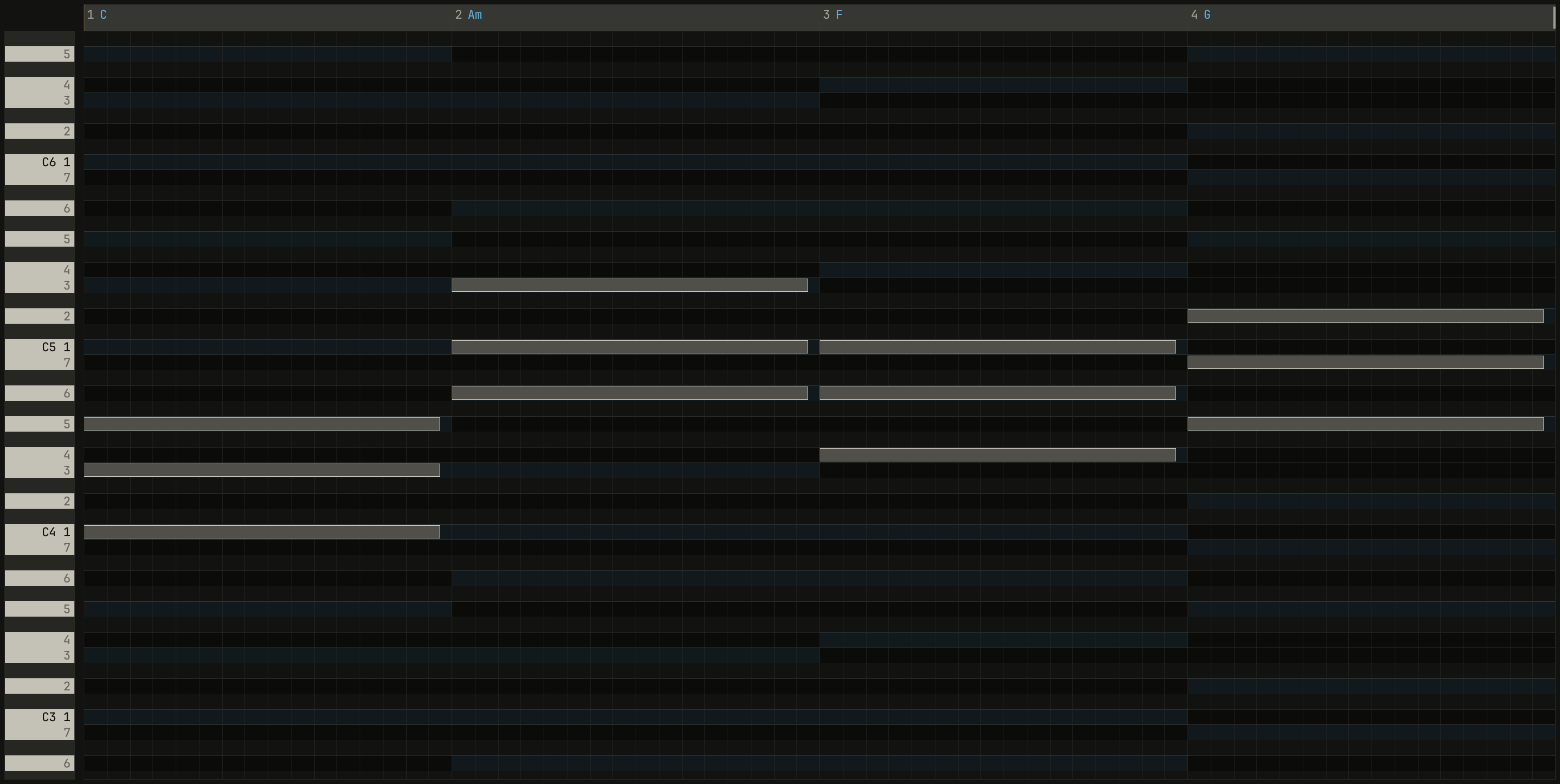
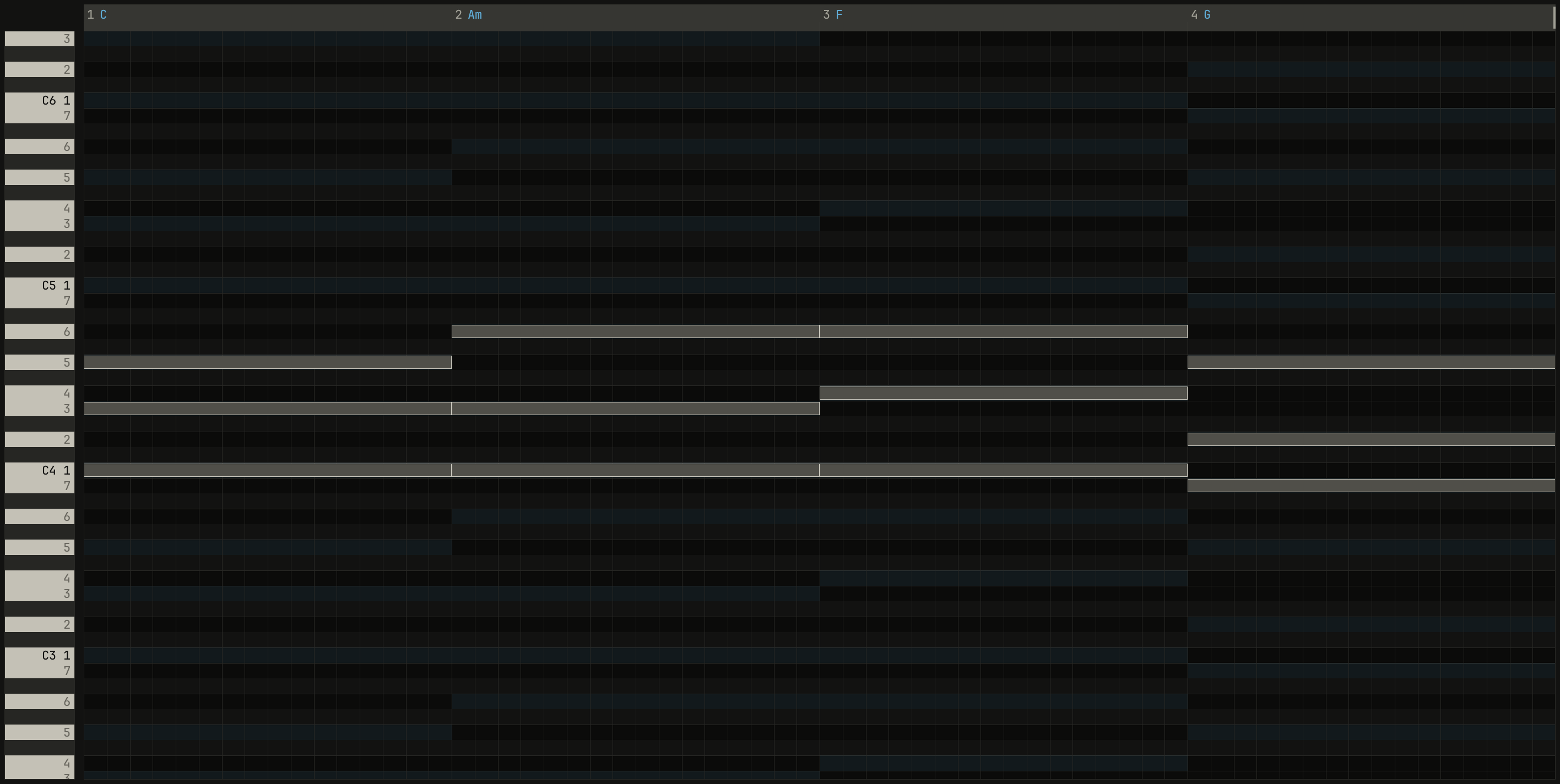
Chords played in root position jump: every note leaps to the new chord's shape. A pianist doesn't play them that way. Each note moves to the nearest note of the next chord, and the notes they share stay put. That's voice leading, and it's why a progression on a piano sounds like one smooth thing rather than a row of blocks.
0.0 / 10.0 s
peak -16.8 dBFS
openzig build run-studio -- manual/04-chords/voicing --view editor --track 1
renderzig build run-studio -- render manual/04-chords/voicing root.wav --from 1 --to 5
voicing/song.json
{
  "tempo": 96,
  "end": "9",
  "key": ["1 C major"],
  "chords": ["1 C", "2 Am", "3 F", "4 G", "5 C", "6 Am", "7 F", "8 G"],
  "devices": [
    { "name": "synth", "type": "synth", "state": { "parts": [{ "patch": "A45", "level": -2, "reverb_send": 15 }] } }
  ],
  "tracks": [
    { "name": "root", "device": "synth", "channel": 1, "keys": "chord", "role": "chords", "clips": [{ "at": "1", "length": "4.0.0", "notes": "root" }] },
    { "name": "led", "device": "synth", "channel": 1, "keys": "chord", "role": "chords", "clips": [{ "at": "5", "length": "4.0.0", "notes": "led" }] }
  ],
  "notes": {
    "root": {
      "length": "4.0.0",
      "notes": [
        "1.1.0 C4 0.3.840 92", "1.1.0 E4 0.3.840 92", "1.1.0 G4 0.3.840 92",
        "2.1.0 A4 0.3.840 92", "2.1.0 C5 0.3.840 92", "2.1.0 E5 0.3.840 92",
        "3.1.0 F4 0.3.840 92", "3.1.0 A4 0.3.840 92", "3.1.0 C5 0.3.840 92",
        "4.1.0 G4 0.3.840 92", "4.1.0 B4 0.3.840 92", "4.1.0 D5 0.3.840 92"
      ]
    },
    "led": { "length": "4.0.0", "follow": { "pattern": "whole", "low": "F3" } }
  }
}
0.0 / 10.0 s
peak -17.9 dBFS
openzig build run-studio -- manual/04-chords/voicing --view editor --track 2
renderzig build run-studio -- render manual/04-chords/voicing led.wav --from 5 --to 9
voicing/song.json
{
  "tempo": 96,
  "end": "9",
  "key": ["1 C major"],
  "chords": ["1 C", "2 Am", "3 F", "4 G", "5 C", "6 Am", "7 F", "8 G"],
  "devices": [
    { "name": "synth", "type": "synth", "state": { "parts": [{ "patch": "A45", "level": -2, "reverb_send": 15 }] } }
  ],
  "tracks": [
    { "name": "root", "device": "synth", "channel": 1, "keys": "chord", "role": "chords", "clips": [{ "at": "1", "length": "4.0.0", "notes": "root" }] },
    { "name": "led", "device": "synth", "channel": 1, "keys": "chord", "role": "chords", "clips": [{ "at": "5", "length": "4.0.0", "notes": "led" }] }
  ],
  "notes": {
    "root": {
      "length": "4.0.0",
      "notes": [
        "1.1.0 C4 0.3.840 92", "1.1.0 E4 0.3.840 92", "1.1.0 G4 0.3.840 92",
        "2.1.0 A4 0.3.840 92", "2.1.0 C5 0.3.840 92", "2.1.0 E5 0.3.840 92",
        "3.1.0 F4 0.3.840 92", "3.1.0 A4 0.3.840 92", "3.1.0 C5 0.3.840 92",
        "4.1.0 G4 0.3.840 92", "4.1.0 B4 0.3.840 92", "4.1.0 D5 0.3.840 92"
      ]
    },
    "led": { "length": "4.0.0", "follow": { "pattern": "whole", "low": "F3" } }
  }
}
The studio voices a chord by trying every inversion, the chord with another
of its notes at the bottom, at every octave that fits the part's range, and
keeping the one whose notes move least from the chord before, counting the
semitones each note moves. Dmitri Tymoczko measures voice leading the same
way. The keys in chord voice each chord from the last one you played, and
so do the parts that follow the chord row, like the second clip here, which
the chord row writes.
Try it in the window
- Select a track, set its way to play to
chordwithplays ▾in the inspector, and play the home row in order, thenA,H,F,G: C, Am, F, G, each led from the chord before. - Hold
Yand playF; holdUand playH. Then tryWwith each white key. - In the
triadssong, click a chord on the row and step through the chord list with Up and Down while the song plays. - Rest the pointer on each chord of the row and read what it does.
- Turn on
I ii, and change the key from C major to G major with Shift+Enter in the key list, in the bar: the names change, and the numerals don't.
Next: chapter 5, progressions, chords one after another.