I. The voices
Toms, congas, rim shot, and claves
Chapter 1's bridged-T network makes the 808's other drums too, tuned higher and damped sooner: three toms, three congas in their place, a rim shot, and claves in its place. This chapter plays each, and turns the 808's tuning knobs and the 909's decay knobs that the drum machine adds to the toms.
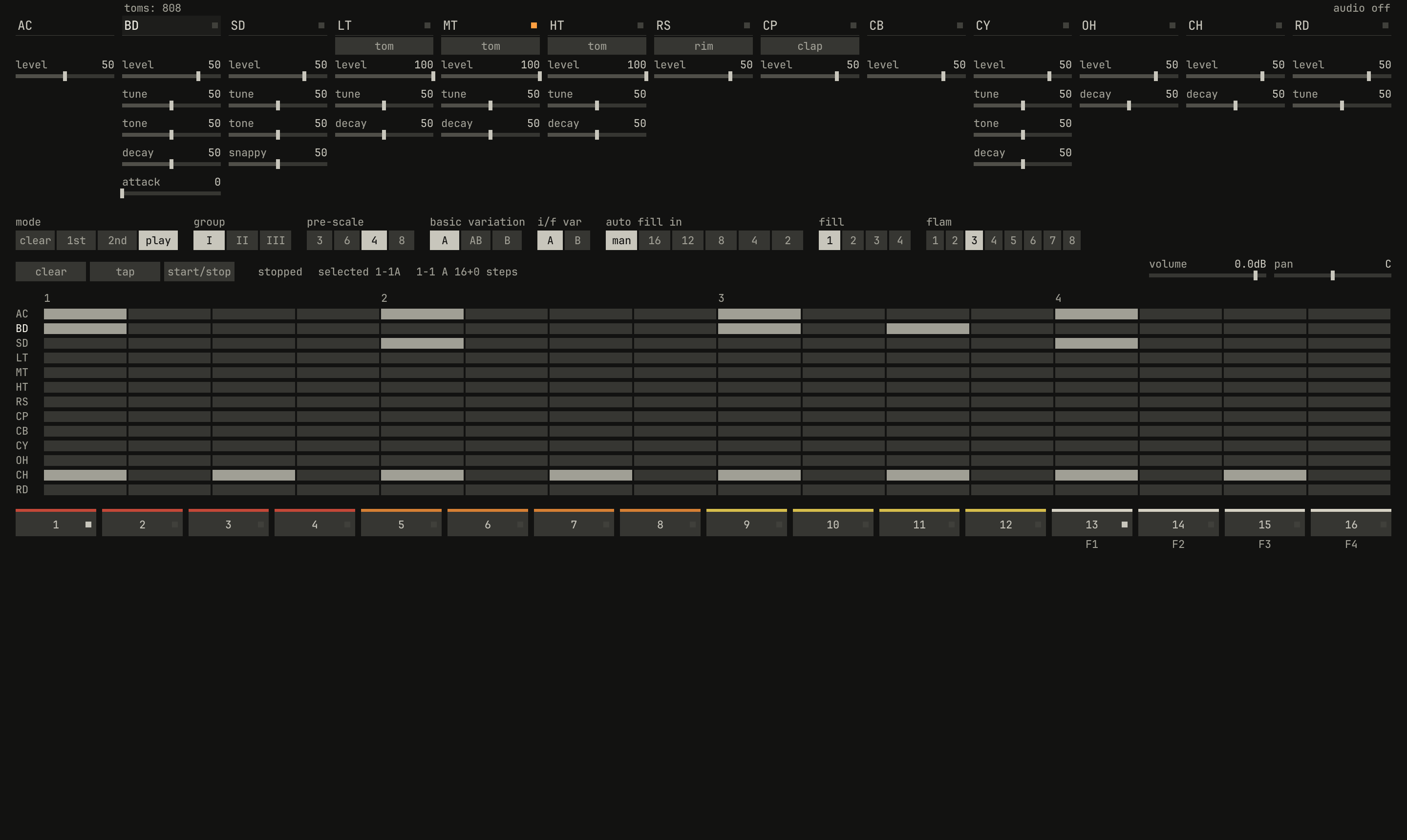
zig build run-studio -- manual/drums/02-toms/toms --view device
Three toms
0.0 / 4.0 s
peak -16.5 dBFS
openzig build run-studio -- manual/drums/02-toms/toms --view device --play 1
renderzig build run-studio -- render manual/drums/02-toms/toms toms.wav
toms/song.json
{
  "tempo": 120,
  "end": "3",
  "devices": [{ "name": "808", "type": "drums", "state": { "voices": { "lt": { "level": 100 }, "mt": { "level": 100 }, "ht": { "level": 100 } } } }],
  "tracks": [
    {
      "name": "toms", "device": "808", "channel": 1, "role": "drums",
      "clips": [{ "at": "1", "length": "2.0.0", "notes": "toms" }],
      "lanes": { "lt_conga": ["1 tom", "2 conga"], "mt_conga": ["1 tom", "2 conga"], "ht_conga": ["1 tom", "2 conga"] }
    }
  ],
  "notes": {
    "toms": { "length": "1.0.0", "notes": ["1.1.0 C3 0.0.240 64", "1.2.0 A2 0.0.240 64", "1.3.0 F2 0.0.240 64"] }
  }
}
A tom is the bass drum's network with smaller parts: it rings higher and
dies sooner. The drum machine tunes its three to the service notes' table
(page 14): the hi tom at 185 Hz, falling to a tenth in 100 milliseconds;
the mid tom at 135 Hz, in 130; the low tom at 90 Hz, in 200. The clip
measures the same: 185, 137, and 90 Hz, falling to a tenth in 99, 130, and
207 milliseconds. Played one after another, high to low, they're the fill
every drummer plays down the kit, and group 1's tom fill is one.
Each tom sighs as the bass drum does, for a similar reason. The service notes, page 6:
While the oscillation is large in amplitude immediately after triggering, it is on a higher frequency due to conductions of D80 and D81, which reduce time constant of the filter. As the resonance is damped, its frequency is lowered by the effect of increasing diodes' internal resistance.
The pitch plot shows each start about 5% high, falling as it fades. A hit at the full accent starts up to 20% high, about a minor third, and the drop is the sound of an 808 tom: listen for it on accented toms.
The 808 mixes a little noise under its toms, decaying slower than the drum, "to provide artificial reveberation", as the service notes put it. The drum machine does too, low-passed at 1.5 kHz and about 30 dB under the drum: you hear it as a breath at the end of the hit rather than as noise.
Tune
0.0 / 6.0 s
peak -16.6 dBFS
tune at 0, 50, and 100, and decay at 80. It settles near 80, 91, and 101 Hz, the table's low, middle, and high.openzig build run-studio -- manual/drums/02-toms/tune
renderzig build run-studio -- render manual/drums/02-toms/tune tune.wav
tune/song.json
{
  "tempo": 120,
  "end": "4",
  "devices": [{ "name": "808", "type": "drums", "state": { "voices": { "lt": { "level": 100, "decay": 80 } } } }],
  "tracks": [
    {
      "name": "tom", "device": "808", "channel": 1, "role": "drums",
      "clips": [{ "at": "1", "length": "3.0.0", "notes": "tom" }],
      "lanes": { "lt_tune": ["1 0", "2 50", "3 100"] }
    }
  ],
  "notes": {
    "tom": { "length": "1.0.0", "notes": ["1.1.0 F2 0.0.240 64"] }
  }
}
The 808's toms have tune, and the table gives each tom's frequency with
its tuning knob low, centered, and high: 80, 90, and 100 Hz for the low
tom, 120, 135, and 160 for the mid, and 165, 185, and 220 for the hi. The
drum machine's tune sweeps between them, and the clip measures 80, 91,
and 101 Hz. That's a range of about four semitones either side of the
middle, enough to tune a tom to a note of the song, not to play a melody.
The 909's manual, page 7, has another idea: "Controling the pitch of these three Tom sounds, you can use them as Melody Tom." With the three toms tuned to three notes, a tom fill is a phrase.
Decay
0.0 / 6.0 s
peak -16.7 dBFS
decay at 0, 50, and 100. It falls 20 dB in 82, 202, and 484 milliseconds.openzig build run-studio -- manual/drums/02-toms/decay
renderzig build run-studio -- render manual/drums/02-toms/decay decay.wav
decay/song.json
{
  "tempo": 120,
  "end": "4",
  "devices": [{ "name": "808", "type": "drums", "state": { "voices": { "lt": { "level": 100 } } } }],
  "tracks": [
    {
      "name": "tom", "device": "808", "channel": 1, "role": "drums",
      "clips": [{ "at": "1", "length": "3.0.0", "notes": "tom" }],
      "lanes": { "lt_decay": ["1 0", "2 50", "3 100"] }
    }
  ],
  "notes": {
    "tom": { "length": "1.0.0", "notes": ["1.1.0 F2 0.0.240 64"] }
  }
}
The 808's toms have no decay knob. The 909's do, and the drum machine
gives each tom one that spreads its decay time around the 808's: at 50 it's
the 808's, at 0 a little under half that, and at 100 a little over twice. A
short tom is a knock; a long one booms, and with a high tune sings. The
909's manual, page 7: "If you wish to mute the Tom sound, rotate this knob
counterclockwise."
decay and tune don't touch each other: the hits in the tune figure each
fall 20 dB in 0.33 seconds.
Congas
0.0 / 2.0 s
peak -16.9 dBFS
conga: the hi, mid, and low conga, near 400, 280, and 185 Hz, falling 20 dB in 81, 101, and 183 milliseconds.openzig build run-studio -- manual/drums/02-toms/toms
renderzig build run-studio -- render manual/drums/02-toms/toms congas.wav --from 2 --to 3
toms/song.json
{
  "tempo": 120,
  "end": "3",
  "devices": [{ "name": "808", "type": "drums", "state": { "voices": { "lt": { "level": 100 }, "mt": { "level": 100 }, "ht": { "level": 100 } } } }],
  "tracks": [
    {
      "name": "toms", "device": "808", "channel": 1, "role": "drums",
      "clips": [{ "at": "1", "length": "2.0.0", "notes": "toms" }],
      "lanes": { "lt_conga": ["1 tom", "2 conga"], "mt_conga": ["1 tom", "2 conga"], "ht_conga": ["1 tom", "2 conga"] }
    }
  ],
  "notes": {
    "toms": { "length": "1.0.0", "notes": ["1.1.0 C3 0.0.240 64", "1.2.0 A2 0.0.240 64", "1.3.0 F2 0.0.240 64"] }
  }
}
The switch under each tom's name, tom or conga, swaps the network's
parts for smaller ones, as the 808's switch does: a conga rings higher and
shorter, sighs less, and has no noise under it. The table gives the hi,
mid, and low conga 400, 280, and 185 Hz, falling to a tenth in 80, 100, and
180 milliseconds, and the clip measures 400, 281, and 186 Hz, in 81, 101,
and 183. A conga's tune sweeps the table's range for it, from 370 to 455
Hz for the hi conga.
The 808's manual, page 5: "It makes no difference which of the two
instruments is programmed, either may be selected to play back from the
same program." The switch is the voice's, not the rhythm's: a rhythm writes
LT, and plays a tom or a conga by where the switch is.
Rim shot and claves
0.0 / 4.0 s
peak -16.8 dBFS
claves, the claves twice. The rim shot's two peaks are at 1670 and 450 Hz; the claves' one, at 2500 Hz. The wave is the rim shot's first 30 milliseconds.openzig build run-studio -- manual/drums/02-toms/rim
renderzig build run-studio -- render manual/drums/02-toms/rim rim.wav
rim/song.json
{
  "tempo": 120,
  "end": "3",
  "devices": [{ "name": "808", "type": "drums", "state": { "voices": { "rs": { "level": 100 } } } }],
  "tracks": [
    {
      "name": "rim", "device": "808", "channel": 1, "role": "drums",
      "clips": [{ "at": "1", "length": "2.0.0", "notes": "rim" }],
      "lanes": { "rs_claves": ["1 rim", "2 claves"] }
    }
  ],
  "notes": {
    "rim": { "length": "1.0.0", "notes": ["1.1.0 C#2 0.0.240 64", "1.3.0 C#2 0.0.240 64"] }
  }
}
The rim shot is the shortest sound the 808 makes: two networks, at 1667 and 455 Hz, struck together and stopped within 10 milliseconds, the time the table gives it. They go through what the service notes call a swing type VCA, an amplifier whose gain the envelope sets and whose transistor bends loud peaks, adding harmonics as it does. The service notes, page 5:
The swing type VCA shown in Fig. 12 is used to generate metalic sound (noise). This circuit features its output waveform having many high harmonic components to provide ringing metalic sound.
The wave plot shows the result: two pitches beating for a few cycles, then
gone. The drum machine high-passes it at 300 Hz, so it clicks rather than
thumps. Group 1's bossa is the rim shot's rhythm.
With the switch at claves, the voice is one network at 2500 Hz, rung
longer: a hard, high, wooden note, the two sticks of a Latin band. The table
gives the claves 25 milliseconds to fall to a tenth; the drum machine gives
them 35, and the clip measures 35.
Controls
| Name | Range | Default | Curve |
|---|---|---|---|
lt_level | 0% to 100% | 50% | audio |
lt_tune | 0% to 100% | 50% | linear |
lt_decay | 0% to 100% | 50% | linear |
lt_conga | tom / conga | tom | switch |
mt_level | 0% to 100% | 50% | audio |
mt_tune | 0% to 100% | 50% | linear |
mt_decay | 0% to 100% | 50% | linear |
mt_conga | tom / conga | tom | switch |
ht_level | 0% to 100% | 50% | audio |
ht_tune | 0% to 100% | 50% | linear |
ht_decay | 0% to 100% | 50% | linear |
ht_conga | tom / conga | tom | switch |
rs_level | 0% to 100% | 50% | audio |
rs_claves | rim / claves | rim | switch |
Next: chapter 3, snare, clap, and maracas, where noise comes in.