I. The voices
Snare, clap, and maracas
A drum rings at a pitch; a snare drum also rattles, from the wires stretched under its lower head, and a hand clap is all rattle. The 808 makes the rattle from noise, a signal that's random from one moment to the next, with every frequency in it at once, filtered and shaped by an envelope. This chapter takes the snare, the noise voice with a drum in it, then the clap and the maracas, which are noise alone.
zig build run-studio -- manual/drums/03-snare/snare --view device
A drum and its snares
0.0 / 2.0 s
peak -17.5 dBFS
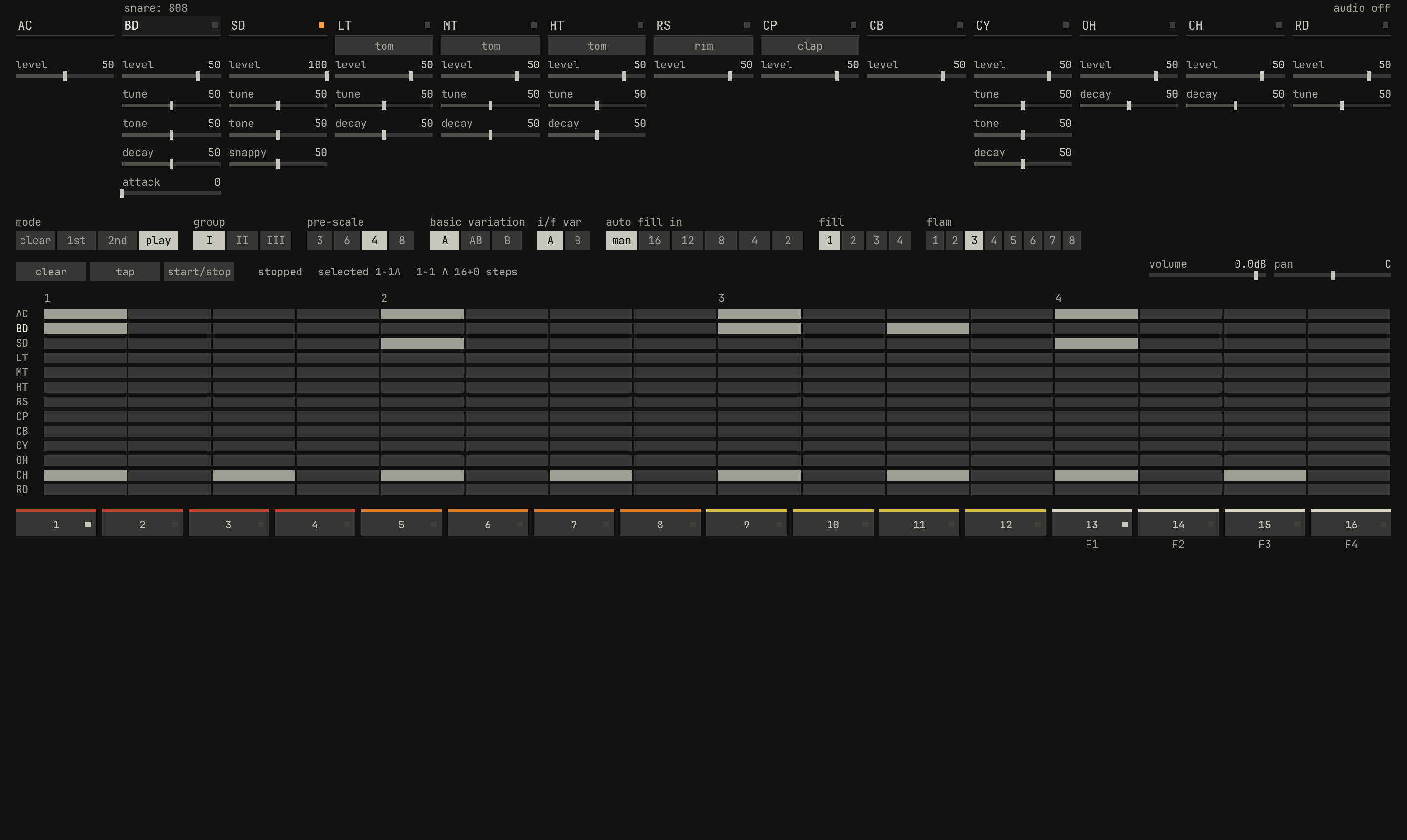
SD column's level, at 100. The wave is the first hit's first 120 milliseconds: a drum's tone with a fizz on it. The spectrum has the drum's two peaks, at 238 and 476 Hz, and the snares' broad hump around 5 kHz.openzig build run-studio -- manual/drums/03-snare/snare --view device --play 1
renderzig build run-studio -- render manual/drums/03-snare/snare snare.wav
snare/song.json
{
  "tempo": 120,
  "end": "2",
  "devices": [{ "name": "808", "type": "drums", "state": { "voices": { "sd": { "level": 100 } } } }],
  "tracks": [
    { "name": "snare", "device": "808", "channel": 1, "role": "drums", "clips": [{ "at": "1", "length": "1.0.0", "notes": "snare" }] }
  ],
  "notes": {
    "snare": { "length": "1.0.0", "notes": ["1.1.0 D2 0.0.240 64", "1.3.0 D2 0.0.240 64"] }
  }
}
Listen for a short tone with a hiss on top, the hiss lasting a little longer. The 808's snare is two bridged-T networks, struck together: one at 238 Hz, the drum's fundamental, and one at 476 Hz, an octave up, its harmonic. Under them is white noise through a band-pass filter, centered here at 5 kHz, with an envelope of its own: the snares. The service notes, page 6:
This sound generator has two bridged T-networks for fundamental waveforms and harmonic waveforms. The output ratio of the two can be changed by VR8 to tailor sound characteristic. The amplitude of snappy envelope can be controlled by VR9.
The table (page 14) gives the snare the two frequencies, as periods of 4.2 and 2.1 milliseconds, and a decay of 60 milliseconds to a tenth. The drum machine's lower network falls to a tenth in 63 milliseconds and its upper one in 44; the snares hiss on, falling to a tenth in 124. The whole hit falls 20 dB in 73 milliseconds.
Snappy
0.0 / 6.0 s
peak -16.0 dBFS
snappy at 0, 50, and 100. At 0 there's no noise at all, and the spectrum is the two peaks; at 100 the snares are as loud as the drum. The level falls faster without them.openzig build run-studio -- manual/drums/03-snare/snappy
renderzig build run-studio -- render manual/drums/03-snare/snappy snappy.wav
snappy/song.json
{
  "tempo": 120,
  "end": "4",
  "devices": [{ "name": "808", "type": "drums", "state": { "voices": { "sd": { "level": 100 } } } }],
  "tracks": [
    {
      "name": "snare", "device": "808", "channel": 1, "role": "drums",
      "clips": [{ "at": "1", "length": "3.0.0", "notes": "snare" }],
      "lanes": { "sd_snappy": ["1 0", "2 50", "3 100"] }
    }
  ],
  "notes": {
    "snare": { "length": "1.0.0", "notes": ["1.1.0 D2 0.0.240 64"] }
  }
}
snappy is how loud the snares are, from none to as loud as the drum. The
808's manual, page 6, says what it stands for:
The SNARE DRUM has variable LEVEL, TONE, and a SNAPPY control that simulates the sound of the snares moving closer to and farther from the bottom drum head.
At 0 the snare is a pitched drum, falling 20 dB in 56 milliseconds, and the 909's manual, page 7, says so: "At its fully counterclockwise position, Snare Drum sound with snappy removed will be obtained." At 50 the noise is 5 dB under the drum, measured over the hit's first 0.9 seconds, and at 100 it's 1 dB over it, so the hit lasts longer, 98 milliseconds to a tenth. A tight funk snare wants it low; a big 808 snare in a ballad wants it high.
Tone
0.0 / 4.0 s
peak -20.2 dBFS
tone at 0, then at 100, with snappy at 0 so the drum is alone. At 0 the 238 Hz peak stands 19 dB over the 476 Hz one; at 100 the two are level.openzig build run-studio -- manual/drums/03-snare/tone
renderzig build run-studio -- render manual/drums/03-snare/tone tone.wav
tone/song.json
{
  "tempo": 120,
  "end": "3",
  "devices": [{ "name": "808", "type": "drums", "state": { "voices": { "sd": { "level": 100, "snappy": 0 } } } }],
  "tracks": [
    {
      "name": "snare", "device": "808", "channel": 1, "role": "drums",
      "clips": [{ "at": "1", "length": "2.0.0", "notes": "snare" }],
      "lanes": { "sd_tone": ["1 0", "2 100"] }
    }
  ],
  "notes": {
    "snare": { "length": "1.0.0", "notes": ["1.1.0 D2 0.0.240 64"] }
  }
}
tone is the balance of the two networks: the fundamental at 0, the
harmonic at 100. At 0 the upper network is almost gone, and the snare is a
dull thud; at 100 it's as strong as the lower one, and since it dies
sooner, the start of the hit is higher and harder. The 909's manual, page
7: "As you rotate this knob, the sound will become brighter."
tune, the 909's, moves both networks together, by 0.4 of an octave either
way: from 180 and 361 Hz at 0 to 314 and 628 Hz at 100. The snares stay
where they are.
The hand clap
0.0 / 2.0 s
peak -10.6 dBFS
level 100. The wave shows three strikes 11 milliseconds apart, then a tail that falls 20 dB in about 120 milliseconds.openzig build run-studio -- manual/drums/03-snare/clap
renderzig build run-studio -- render manual/drums/03-snare/clap clap.wav
clap/song.json
{
  "tempo": 120,
  "end": "2",
  "devices": [{ "name": "808", "type": "drums", "state": { "voices": { "cp": { "level": 100 } } } }],
  "tracks": [
    { "name": "clap", "device": "808", "channel": 1, "role": "drums", "clips": [{ "at": "1", "length": "1.0.0", "notes": "clap" }] }
  ],
  "notes": {
    "clap": { "length": "1.0.0", "notes": ["1.1.0 D#2 0.0.240 64", "1.3.0 D#2 0.0.240 64"] }
  }
}
A hand clap is many hands, not quite together: a few sharp cracks and a room answering. The 808's is noise through a band-pass filter, around 1 kHz here, through two amplifiers at once. One's envelope is a sawtooth that strikes three times in about 30 milliseconds, the claps; the other decays slowly, the room. The service notes, page 6:
White noise passed through the band pass filter (IC21) is applied to two VCAs in parallel to have different envelopes. These envelopes are combined to obtain sound source for the CP sound generator. Since an envelope with a relatively long decay time is applied to the VCA Q70, output from this VCA constitutes reverberation of CP sound.
The drum machine's strikes come 11 milliseconds apart, each dying in 6, and
its tail falls to a tenth in 120 milliseconds; the table gives the clap 100.
The clap is the loudest voice at a given level: the table gives it 6
volts without accent, where most voices have 3 or 3.5, and at level 100
it peaks at −11.9 dBFS, where the bass drum peaks at −17.1.
Maracas
0.0 / 2.0 s
peak -9.7 dBFS
maracas. Each shake is noise above 5 kHz, gone in 25 milliseconds.openzig build run-studio -- manual/drums/03-snare/maracas
renderzig build run-studio -- render manual/drums/03-snare/maracas maracas.wav
maracas/song.json
{
  "tempo": 120,
  "end": "2",
  "devices": [{ "name": "808", "type": "drums", "state": { "voices": { "cp": { "level": 100, "maracas": "maracas" } } } }],
  "tracks": [
    { "name": "maracas", "device": "808", "channel": 1, "role": "drums", "clips": [{ "at": "1", "length": "1.0.0", "notes": "shake" }] }
  ],
  "notes": {
    "shake": { "length": "1.0.0", "notes": ["1.1.0 D#2 0.0.240 64", "1.1.480 D#2 0.0.240 64", "1.2.0 D#2 0.0.240 64", "1.2.480 D#2 0.0.240 64", "1.3.0 D#2 0.0.240 64", "1.3.480 D#2 0.0.240 64", "1.4.0 D#2 0.0.240 64", "1.4.480 D#2 0.0.240 64"] }
  }
}
With the switch under CP at maracas, the voice is a short burst of
high-passed noise: white noise above 5 kHz, falling to a tenth in 25
milliseconds, the shortest of the table's values for it. The spectrum has
almost nothing below 3 kHz, 26 dB under the rest. In 8ths or 16ths it's a
shaker under a groove; as a rhythm's only high voice, it stands in for a
hi-hat.
Controls
| Name | Range | Default | Curve |
|---|---|---|---|
sd_level | 0% to 100% | 50% | audio |
sd_tune | 0% to 100% | 50% | linear |
sd_tone | 0% to 100% | 50% | linear |
sd_snappy | 0% to 100% | 50% | linear |
cp_level | 0% to 100% | 50% | audio |
cp_maracas | clap / maracas | clap | switch |
Next: chapter 4, the metal, where six square waves make the cymbals.