I. The voices
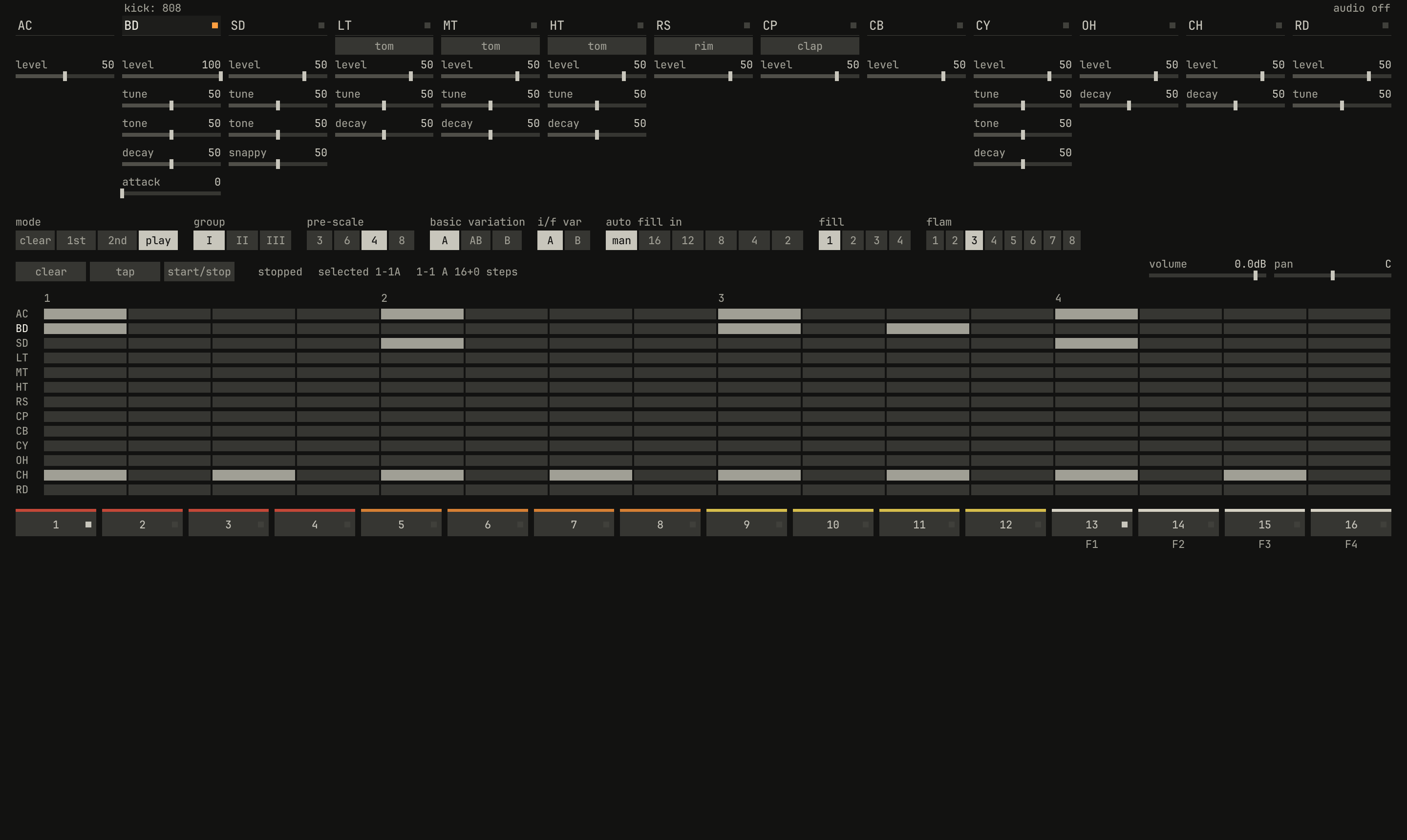
The bass drum
The 808's bass drum is the drum machine's most famous sound, and the
simplest to explain: a filter that rings when it's struck, like a bell, and
dies away. This chapter strikes it, watches it ring, and turns each of its
five knobs: the 808's level, tone, and decay, and the 909's tune and
attack. Every song in it plays the bass drum alone, with its level at
100 so it's easy to hear.
zig build run-studio -- manual/drums/01-bass-drum/kick --view device
A filter that rings
0.0 / 4.0 s
peak -17.1 dBFS
BD column's level, at 100. The picture is 50 milliseconds in, with the BD light lit. The wave is the first half second of the first hit: one frequency, fading. The spectrum is its one peak, at 55 Hz.openzig build run-studio -- manual/drums/01-bass-drum/kick --view device --play 1
renderzig build run-studio -- render manual/drums/01-bass-drum/kick kick.wav
kick/song.json
{
  "tempo": 120,
  "end": "3",
  "devices": [{ "name": "808", "type": "drums", "state": { "voices": { "bd": { "level": 100 } } } }],
  "tracks": [
    { "name": "kick", "device": "808", "channel": 1, "role": "drums", "clips": [{ "at": "1", "length": "2.0.0", "notes": "kick" }] }
  ],
  "notes": {
    "kick": { "length": "1.0.0", "notes": ["1.1.0 C2 0.0.240 64"] }
  }
}
Listen for a low thump, more felt than heard, that dies in a fraction of a second. The wave plot shows what it is: a sine wave, the purest tone there is, that starts at full height and shrinks by the same share every cycle. The spectrum has one peak, near 55 Hz, an A two octaves below the A under middle C. Everything else in the clip is far below it.
The 808 made it with a bridged-T network: a small filter of resistors and capacitors around an amplifier, with enough of its output fed back that it rings at its own frequency when a pulse strikes it, and fades as the circuit loses energy. The service notes, page 5:
The bridged T-network filter shown in Fig. 11 is used to generate periodic damping drum sound. This configuration has variations according to application (instrument sound). Values of R and C can be changed. With this circuit, the decay time becomes longer as Q increases.
The drum machine does the same with numbers: a point that turns round a circle a little each sample, at the drum's frequency, and moves in toward the middle a little too, so its height traces a sine that shrinks. A hit pushes the point outward. The toms, the congas, the rim shot, the claves, and the snare's body, in the next chapters, are the same network with other values.
Decay
0.0 / 6.0 s
peak -16.9 dBFS
decay at 0, 50, and 100, a bar each, overlaid from each hit's start. The level falls in a straight line, by the same number of decibels each second, and the knob sets how steep.openzig build run-studio -- manual/drums/01-bass-drum/decay
renderzig build run-studio -- render manual/drums/01-bass-drum/decay decay.wav
decay/song.json
{
  "tempo": 120,
  "end": "4",
  "devices": [{ "name": "808", "type": "drums", "state": { "voices": { "bd": { "level": 100 } } } }],
  "tracks": [
    {
      "name": "kick", "device": "808", "channel": 1, "role": "drums",
      "clips": [{ "at": "1", "length": "3.0.0", "notes": "kick" }],
      "lanes": { "bd_decay": ["1 0", "2 50", "3 100"] }
    }
  ],
  "notes": {
    "kick": { "length": "1.0.0", "notes": ["1.1.0 C2 0.0.240 64"] }
  }
}
decay is how much of its energy the network keeps from one cycle to the
next: the 808's feedback, which the service notes call VR6. The level plot
draws it, in decibels against time. A sound that loses the same share of
its level every moment falls in a straight line there, and the bass drum
does, from the first cycle to silence.
The 808's service notes time each voice's decay as the time it takes to
fall to a tenth of its height, 20 dB, with the knob at its least, its
middle, and its most (page 14). For the bass drum they're 50, 300, and 800
milliseconds, and the drum machine measures the same: with decay at 0 it
falls 20 dB in 50 ms, at 50 in 300 ms, and at 100 in 800 ms. At 0 it's a
short, dry knock; at 100 it booms on for more than a second. The 808's manual, page 13, on the knob turned down:
the BASS DRUM has a variable Decay which is shortened by turning the Decay control to the left, causing much the same effect as muffling a real bass drum head.
The first half cycle
0.0 / 2.0 s
peak -7.8 dBFS
openzig build run-studio -- manual/drums/01-bass-drum/sigh
renderzig build run-studio -- render manual/drums/01-bass-drum/sigh attack-cycle.wav --from 1 --to 2
sigh/song.json
{
  "tempo": 120,
  "end": "3",
  "devices": [{ "name": "808", "type": "drums", "state": { "accent": 100, "voices": { "bd": { "level": 100, "decay": 100 } } } }],
  "tracks": [
    { "name": "kick", "device": "808", "channel": 1, "role": "drums", "clips": [{ "at": "1", "length": "2.0.0", "notes": "kick" }] }
  ],
  "notes": {
    "kick": { "length": "2.0.0", "notes": ["1.1.0 C2 0.0.240 96", "2.1.0 C2 0.0.240 64"] }
  }
}
Look at the wave's first hump: it's half as wide as the ones after it. For its first 4 milliseconds the network rings at twice its frequency, then drops to its own. The 808 does this on purpose, with three transistors that change the network's values for that long. The service notes, page 5:
Immediately after a trigger pulse is fed into the generator, the filter's time constant — when ACCENT is present — is halved and has a resonance on twice its inherent frequency for a half cycle period, then on the fixed frequency with decaying amplitude. This changing frequencies will sound a punchier crisp bass.
Half a cycle is too short to hear as a pitch. It's heard as the start of the drum being harder, a knock before the boom. The service notes put it on accented hits; the drum machine does it on every hit, accented or not.
Accent and the sigh
0.0 / 4.0 s
peak -7.8 dBFS
decay at 100. The accented hit is 9 dB louder, and starts higher: near 63 Hz, sighing down to 55 Hz over a second. The hit without accent starts near 57 Hz.openzig build run-studio -- manual/drums/01-bass-drum/sigh
renderzig build run-studio -- render manual/drums/01-bass-drum/sigh sigh.wav
sigh/song.json
{
  "tempo": 120,
  "end": "3",
  "devices": [{ "name": "808", "type": "drums", "state": { "accent": 100, "voices": { "bd": { "level": 100, "decay": 100 } } } }],
  "tracks": [
    { "name": "kick", "device": "808", "channel": 1, "role": "drums", "clips": [{ "at": "1", "length": "2.0.0", "notes": "kick" }] }
  ],
  "notes": {
    "kick": { "length": "2.0.0", "notes": ["1.1.0 C2 0.0.240 96", "2.1.0 C2 0.0.240 64"] }
  }
}
Listen to the first hit's pitch fall as it fades: the 808's sigh. While the network rings loudly, current leaks through a part of it that shouldn't conduct, which raises its frequency; as it quietens, the leak stops and the pitch settles. Werner, Abel, and Smith traced it in their paper on the 808's bass drum (DAFx-14, section 8.2): "This sigh is actually a consequence of leakage through R161."
The drum machine raises the pitch by the network's height: 16% at the full accent's height, less on a softer hit. The pitch plot measures it. At the full accent the hit starts near 62.7 Hz, 30 milliseconds in, falls to 59.6 Hz at 0.2 seconds and 55.4 Hz at 0.8, and settles at 54.5. Without accent it starts near 57.3 Hz. The service notes' table gives the bass drum's frequency as 56 Hz, a period of 18 ms: its pitch partway through the sigh.
Accent is a harder hit. On the 808 it raised the trigger pulse, which struck the network harder, so an accented hit is louder, and here sighs more too. The service notes' table gives the bass drum 3.5 volts peak to peak without accent and 10 volts at the full accent, 9.1 dB more; the level plot measures 9.3. Chapter 5 is accent on every voice.
Tune
0.0 / 6.0 s
peak -17.0 dBFS
tune at 0, 50, and 100, with decay at 70. The pitch settles near 39, 55, and 77 Hz: half an octave down, the middle, and half an octave up.openzig build run-studio -- manual/drums/01-bass-drum/tune
renderzig build run-studio -- render manual/drums/01-bass-drum/tune tune.wav
tune/song.json
{
  "tempo": 120,
  "end": "4",
  "devices": [{ "name": "808", "type": "drums", "state": { "voices": { "bd": { "level": 100, "decay": 70 } } } }],
  "tracks": [
    {
      "name": "kick", "device": "808", "channel": 1, "role": "drums",
      "clips": [{ "at": "1", "length": "3.0.0", "notes": "kick" }],
      "lanes": { "bd_tune": ["1 0", "2 50", "3 100"] }
    }
  ],
  "notes": {
    "kick": { "length": "1.0.0", "notes": ["1.1.0 C2 0.0.240 64"] }
  }
}
The 808's bass drum has no tune. The 909's does, and the drum machine adds
it: tune moves the network's frequency half an octave either way, from
38.5 Hz to 77 Hz, and the clip measures 38.6, 54.6, and 77.2. A bass drum
tuned to the song's key sits under the bass line rather than against it.
In the middle it settles on 54.5 Hz, a slightly flat A; a G, 49 Hz, is
tune near 35, and an E, 41.2 Hz, near 10.
The decay stays where it was: each hit here falls 20 dB in 0.45 seconds, whatever the tune. The 909's manual, page 7:
This is to control the pitch. Whatever the position this knob is set, the Decay knob works at its set time.
Tone
0.0 / 6.0 s
peak -17.0 dBFS
tone at 0, then of one at 100. At 0 the wave rises in a smooth curve and peaks at 3 ms, 1.2 dB lower; at 100 the strike's pulse comes through, as a step at the start and a kink a millisecond in, where the pulse ends.openzig build run-studio -- manual/drums/01-bass-drum/tone
renderzig build run-studio -- render manual/drums/01-bass-drum/tone tone.wav
tone/song.json
{
  "tempo": 120,
  "end": "4",
  "devices": [{ "name": "808", "type": "drums", "state": { "voices": { "bd": { "level": 100 } } } }],
  "tracks": [
    {
      "name": "kick", "device": "808", "channel": 1, "role": "drums",
      "clips": [{ "at": "1", "length": "3.0.0", "notes": "kick" }],
      "lanes": { "bd_tone": ["1 0", "2 50", "3 100"] }
    }
  ],
  "notes": {
    "kick": { "length": "1.0.0", "notes": ["1.1.0 C2 0.0.240 64"] }
  }
}
A strike is a pulse a millisecond long, and some of it leaks past the
network to the output: a click at the start of the hit. tone is a
low-pass filter after the network, over the ring and the leak together, set
from 150 Hz at 0 to 900 Hz at 50 and 5 kHz at 100. The ring at 55 Hz passes
at every setting; what changes is the click. Werner, Abel, and Smith, on
the 808: "Its clicky attack could cut through a mix, but could be dialed
back with a passive tone control."
It's a small control, as on the 808. Of the hit's first 0.3 seconds, what lies above 1 kHz is 50 dB below the whole at 0, 46.5 dB at 50, and 40.4 dB at 100: listen for the start of the hit sharpening, on good speakers or headphones.
Attack
0.0 / 4.0 s
peak -14.4 dBFS
attack at 0, then at 100, the first 50 milliseconds of each overlaid. At 100, a click spreads across the spectrum, 17 dB stronger above 1 kHz. The wave is the first 30 milliseconds of the second hit.openzig build run-studio -- manual/drums/01-bass-drum/attack
renderzig build run-studio -- render manual/drums/01-bass-drum/attack attack.wav
attack/song.json
{
  "tempo": 120,
  "end": "3",
  "devices": [{ "name": "808", "type": "drums", "state": { "voices": { "bd": { "level": 100 } } } }],
  "tracks": [
    {
      "name": "kick", "device": "808", "channel": 1, "role": "drums",
      "clips": [{ "at": "1", "length": "2.0.0", "notes": "kick" }],
      "lanes": { "bd_attack": ["1 0", "2 100"] }
    }
  ],
  "notes": {
    "kick": { "length": "1.0.0", "notes": ["1.1.0 C2 0.0.240 64"] }
  }
}
The 909's bass drum has attack, to put back the click a drummer's beater
makes, and the drum machine adds it: a burst of noise that dies in 3
milliseconds and a sharp edge of the pulse, mixed in at the network's
output. The 909's manual, page 7: "This is to control the attack sound.
Rotating this knob clockwise increases it."
At 0, as the panel opens, there's none, and the bass drum is the 808's. At 100, the part of the hit's first 50 milliseconds above 1 kHz rises from 37 dB below the whole to 20 dB below, and its peak from −17.1 to −14.4 dBFS. In a mix, the click is what lets a kick be heard on small speakers, which can't play 55 Hz.
Hits that overlap
0.0 / 2.0 s
peak -16.9 dBFS
decay at 100. Each strikes the network wherever its ring has got to, so the four come out different: their peaks are −16.9, −19.2, −20.9, and −17.8 dBFS.openzig build run-studio -- manual/drums/01-bass-drum/roll
renderzig build run-studio -- render manual/drums/01-bass-drum/roll roll.wav
roll/song.json
{
  "tempo": 120,
  "end": "2",
  "devices": [{ "name": "808", "type": "drums", "state": { "voices": { "bd": { "level": 100, "decay": 100 } } } }],
  "tracks": [
    { "name": "kick", "device": "808", "channel": 1, "role": "drums", "clips": [{ "at": "1", "length": "1.0.0", "notes": "roll" }] }
  ],
  "notes": {
    "roll": { "length": "1.0.0", "notes": ["1.1.0 C2 0.0.240 64", "1.1.240 C2 0.0.240 64", "1.1.480 C2 0.0.240 64", "1.1.720 C2 0.0.240 64"] }
  }
}
A hit doesn't start the network over: it pushes it from where it is, as a second stroke on a drumhead still moving does. With a long decay, a roll's hits overlap, and each adds to the ring the last left, in whatever part of its cycle that is. Some push with it and some against it, so the hits of a roll differ in level, and none starts from silence. A recording of a single hit, played again and again, can't do that.
Controls
| Name | Range | Default | Curve |
|---|---|---|---|
bd_level | 0% to 100% | 50% | audio |
bd_tune | 0% to 100% | 50% | linear |
bd_tone | 0% to 100% | 50% | linear |
bd_decay | 0% to 100% | 50% | linear |
bd_attack | 0% to 100% | 0% | linear |
Next: chapter 2, toms, congas, rim shot, and claves, the same network tuned higher.