I. The voices
The metal
A cymbal has no pitch: struck, it rings at hundreds of frequencies that don't line up as a note's harmonics do. The 808 fakes that with six square waves at unrelated frequencies, summed, filtered to their upper harmonics, and shaped by envelopes. Its manual calls them "the six-oscillator CYMBAL sound" (page 8), and they make the cymbal, the hi-hats, and, two of them, the cowbell. This chapter starts with the cowbell, where two squares can still be heard as notes, then adds the other four.
zig build run-studio -- manual/drums/04-metal/cowbell --view device
The cowbell
0.0 / 2.0 s
peak -15.3 dBFS
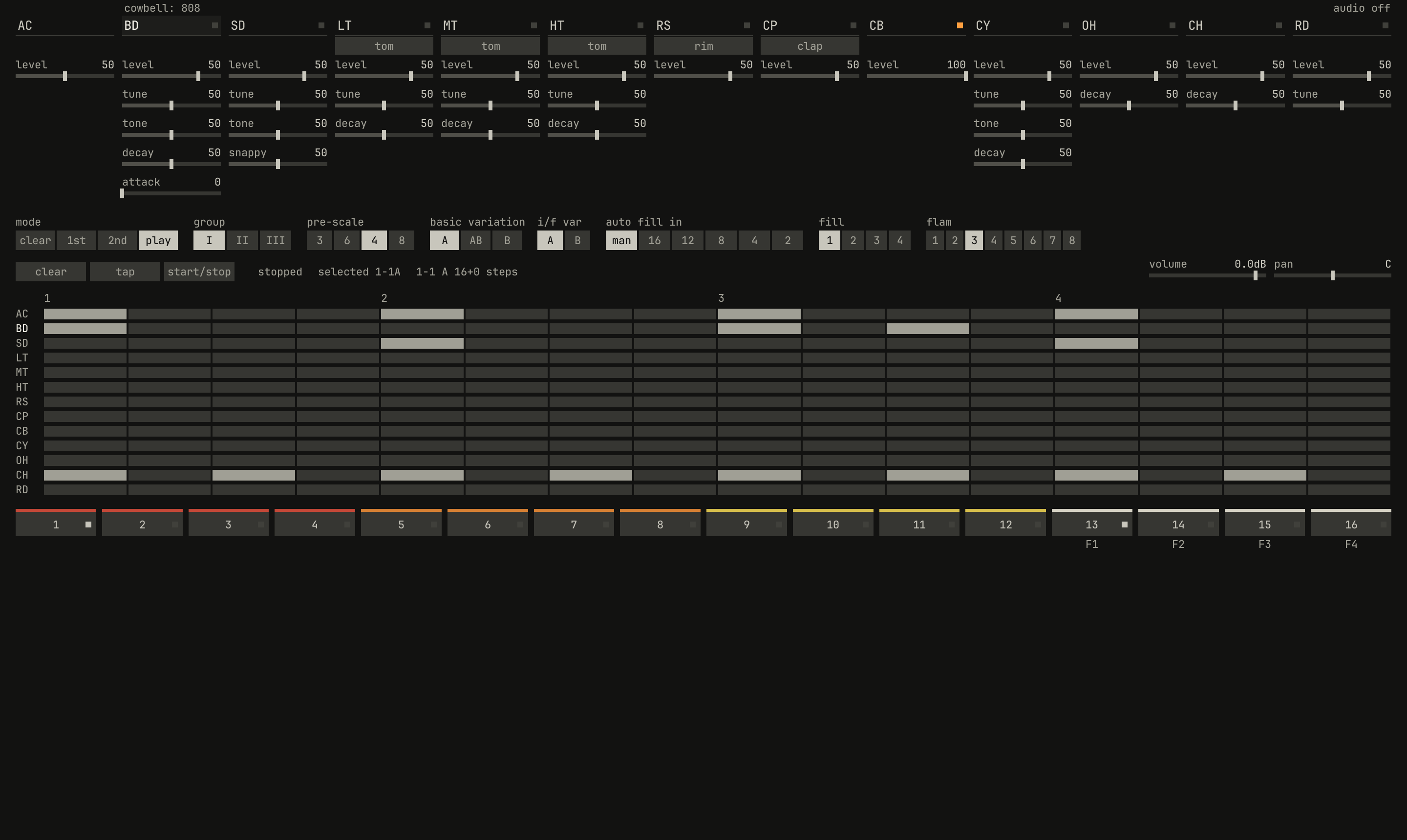
level 100. The spectrum's two tallest peaks are the two squares, 540 and 800 Hz, and the rest are their harmonics. The level falls steeply for the first 20 milliseconds, then slower.openzig build run-studio -- manual/drums/04-metal/cowbell --view device --play 1
renderzig build run-studio -- render manual/drums/04-metal/cowbell cowbell.wav
cowbell/song.json
{
  "tempo": 120,
  "end": "2",
  "devices": [{ "name": "808", "type": "drums", "state": { "voices": { "cb": { "level": 100 } } } }],
  "tracks": [
    { "name": "cowbell", "device": "808", "channel": 1, "role": "drums", "clips": [{ "at": "1", "length": "1.0.0", "notes": "cowbell" }] }
  ],
  "notes": {
    "cowbell": { "length": "1.0.0", "notes": ["1.1.0 G#3 0.0.240 64", "1.3.0 G#3 0.0.240 64"] }
  }
}
Listen for a short, hard, two-note clank. The 808's cowbell is two square waves, at 540 and 800 Hz, each switched on by the envelope and summed through a band-pass filter, here around 1.1 kHz. The two notes are a little under a fifth apart, an interval just out of tune, and the clank is their clash. The service notes, page 6:
This sound generator uses the outputs of two square waveform oscillators with different frequencies (by Schmitt triggers). Each oscillation output passes the corresponding exclusive gate (VCA, Q14, Q15) and mixed by the filter IC2.
A square wave has every odd harmonic: three times its frequency, five times, seven. The spectrum's other peaks are those: 1620 Hz is the third harmonic of 540, 2400 the third of 800, 2700 the fifth of 540, 4000 the fifth of 800. The 808's squares are on for 48% of each cycle rather than half, so the even harmonics, 1080 and 1600 Hz, are there too, weaker.
The envelope has two parts, as the service notes put it: "an envelope having
abrupt level decay at the initial trailing edge to emphasize attack effect."
The level plot shows them: 12 dB down in the first 20 milliseconds, then
about 27 dB every 100, so the hit is 20 dB down in 54 milliseconds; the
table gives the cowbell 50. The cowbell has only level, on the 808 and
here.
Six squares
0.0 / 4.0 s
peak -15.7 dBFS
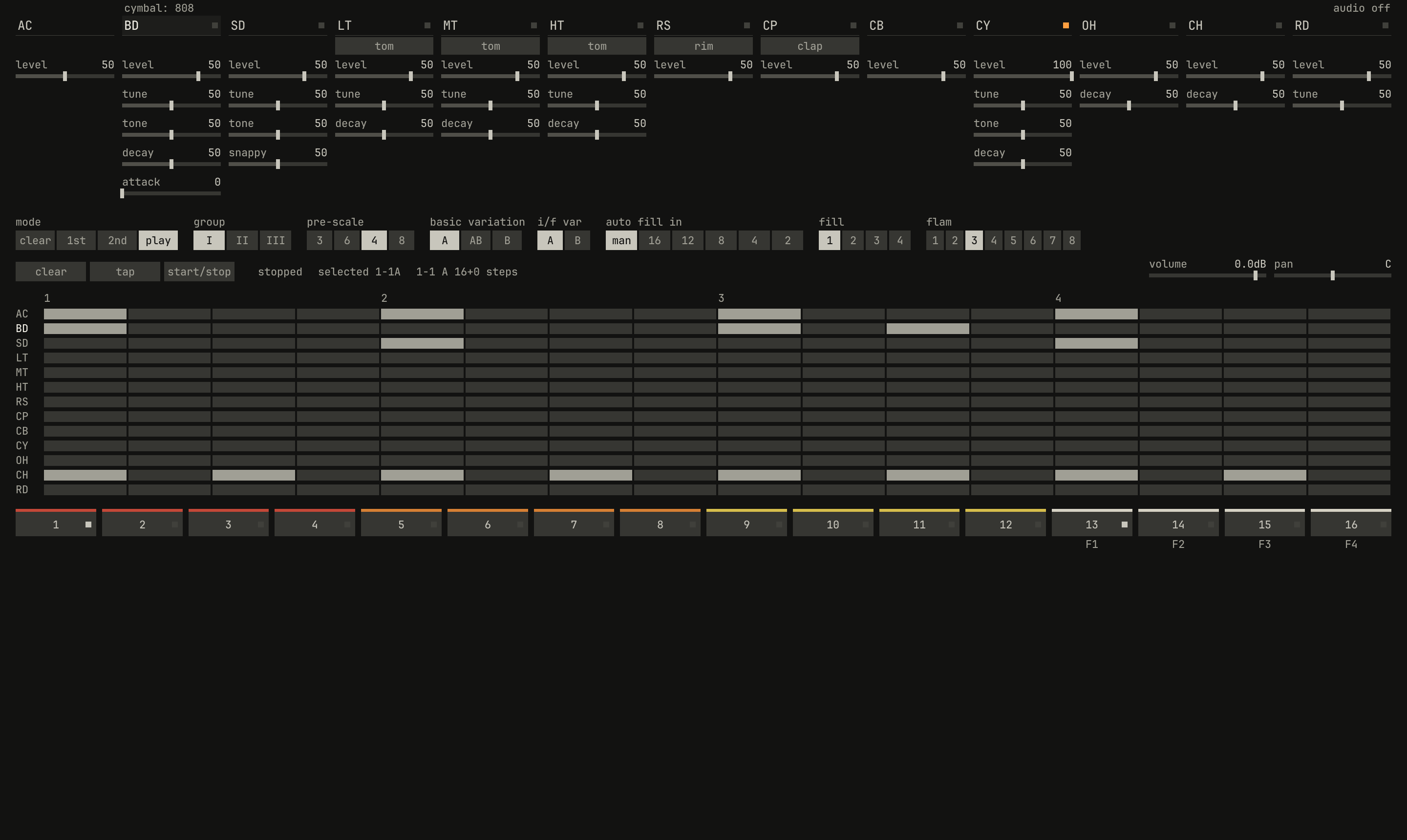
level 100. The spectrum is a forest of peaks from 1.5 to 10 kHz, each an odd harmonic of one of the six squares. The spectrogram shows the highest ones dying first.openzig build run-studio -- manual/drums/04-metal/cymbal --view device --play 1
renderzig build run-studio -- render manual/drums/04-metal/cymbal cymbal.wav
cymbal/song.json
{
  "tempo": 120,
  "end": "3",
  "devices": [{ "name": "808", "type": "drums", "state": { "voices": { "cy": { "level": 100 } } } }],
  "tracks": [
    { "name": "cymbal", "device": "808", "channel": 1, "role": "drums", "clips": [{ "at": "1", "length": "2.0.0", "notes": "cymbal" }] }
  ],
  "notes": {
    "cymbal": { "length": "2.0.0", "notes": ["1.1.0 C#3 0.0.240 64"] }
  }
}
Add four more squares to the cowbell's two, at 205.3, 369.6, 304.4, and 522.7 Hz, and the harmonics of all six crowd the spectrum, none lined up with another. Werner, Abel, and Smith measured the six in their paper on the 808's cymbal (ICMC 2014, section 4), and the drum machine uses their numbers: the first four are fixed by their parts, and the last two are trimmed at the factory to the cowbell's 800 and 540 Hz.
The cymbal sends the sum through two band-pass filters, at 3.44 and 7.1 kHz, which, in the paper's words, "strongly accentuate the upper overtones of the square waves, while deemphasizing their fundamental frequencies." What's left below 1.5 kHz is 20 dB under the rest. The peaks in the spectrum are harmonics far up: 2400 Hz is the third harmonic of 800, 2613 the fifth of 522.7, 2740 the ninth of 304.4, 3326 the ninth of 369.6. With so many, and so close, the ear hears no note, only metal.
Each band goes through a swing-type VCA, as the rim shot does, whose bite adds harmonics of their own, then through a high-pass filter. The 808's manual, page 6, is pleased with the result: "The CYMBAL voice, which remarkably duplicates a crash cymbal sound".
The cymbal's three bands
0.0 / 6.0 s
peak -14.6 dBFS
decay at 0, 50, and 100. From 50 milliseconds in, it falls 20 dB in 0.35, 0.8, and 1.2 seconds, the table's three times.openzig build run-studio -- manual/drums/04-metal/decay
renderzig build run-studio -- render manual/drums/04-metal/decay decay.wav
decay/song.json
{
  "tempo": 120,
  "end": "4",
  "devices": [{ "name": "808", "type": "drums", "state": { "voices": { "cy": { "level": 100 } } } }],
  "tracks": [
    {
      "name": "cymbal", "device": "808", "channel": 1, "role": "drums",
      "clips": [{ "at": "1", "length": "3.0.0", "notes": "cymbal" }],
      "lanes": { "cy_decay": ["1 0", "2 50", "3 100"] }
    }
  ],
  "notes": {
    "cymbal": { "length": "1.0.0", "notes": ["1.1.0 C#3 0.0.240 64"] }
  }
}
The cymbal splits its two bands into three, each with an envelope of its own: the lower band, and the upper one twice, through high-passes at 2, 4.5, and 10.5 kHz. The service notes, page 6:
The output of the gate Q16 has the highest frequency component of this sound generator. Its decay time is short. The output of Q17 is in a frequency range slightly lower than the above output, and its decay time is controllable. These three signals with different frequency ranges are outputted with their level ratio controlled by VR4.
decay sets the lowest band's decay, and the middle one's a little shorter,
70% of it; the highest dies within 0.15 seconds whatever decay says. The
table gives the cymbal 350, 800, and 1200 milliseconds to fall to a tenth,
and the clip measures the same, from 50 milliseconds in, after the highest
band has gone. The 808's manual says the knob is "to simulate the sound of
hitting the Cymbal closer or further from the bell": short near the bell,
long out on the edge.
Tone and tune
0.0 / 6.0 s
peak -15.2 dBFS
tone at 0, then at 100, then at 100 with tune at 0. The plots are the first half second of the last two hits: at tune 0 the whole forest of peaks has moved down half an octave, its lowest from 205 Hz to 145.openzig build run-studio -- manual/drums/04-metal/tone
renderzig build run-studio -- render manual/drums/04-metal/tone tone.wav
tone/song.json
{
  "tempo": 120,
  "end": "4",
  "devices": [{ "name": "808", "type": "drums", "state": { "voices": { "cy": { "level": 100 } } } }],
  "tracks": [
    {
      "name": "cymbal", "device": "808", "channel": 1, "role": "drums",
      "clips": [{ "at": "1", "length": "3.0.0", "notes": "cymbal" }],
      "lanes": { "cy_tone": ["1 0", "2 100"], "cy_tune": ["1 50", "3 0"] }
    }
  ],
  "notes": {
    "cymbal": { "length": "1.0.0", "notes": ["1.1.0 C#3 0.0.240 64"] }
  }
}
tone is VR4: how much of the highest band sounds, from 15% at 0 to all of
it at 100. Since that band is the one that dies within 0.15 seconds, tone
is the sizzle at the start of the hit, and a small change: of the first 0.1
seconds, the part above 12 kHz is 17.2 dB under the whole at 0, and 14.2 dB
at 100. Listen for the first hit's start being duller than the second's.
tune is the 909's crash tune, which the drum machine gives the cymbal: it
moves all six squares together, half an octave either way, so every peak
moves with them, 2400 Hz to 1697 at 0. The 909's manual, page 7, names it
"Tone" on its crash and ride: "This is to adjust the pitch of the Cymbal
sound."
Open and closed hi-hats
0.0 / 4.0 s
peak -13.0 dBFS
openzig build run-studio -- manual/drums/04-metal/hats
renderzig build run-studio -- render manual/drums/04-metal/hats hats.wav
hats/song.json
{
  "tempo": 120,
  "end": "3",
  "devices": [{ "name": "808", "type": "drums", "state": { "voices": { "oh": { "level": 100 }, "ch": { "level": 100 } } } }],
  "tracks": [
    { "name": "hats", "device": "808", "channel": 1, "role": "drums", "clips": [{ "at": "1", "length": "2.0.0", "notes": "hats" }] }
  ],
  "notes": {
    "hats": { "length": "2.0.0", "notes": ["1.1.0 A#2 0.0.240 64", "1.3.0 F#2 0.0.240 64", "2.1.0 A#2 0.0.240 64", "2.1.240 F#2 0.0.240 64"] }
  }
}
The hi-hats are the metal's upper band, at 7.1 kHz, each through its own
envelope, swing-type VCA, and high-pass, at 7 kHz for the open hi-hat and
7.5 for the closed. The two share one set of six squares, as the 808's do,
so they're the same metal, ringing for different lengths: the open hi-hat
falls 20 dB in 0.47 seconds with decay at 50, and the closed one in 55
milliseconds. The cymbal has a set of its own here, so its tune moves it
alone.
The open hi-hat's decay runs from 90 milliseconds at 0 to 0.47 seconds at
50 and 0.61 at 100, by the table's 90, 450, and 600. The closed hi-hat's
decay is the 909's, which the 808 lacks: 25, 55, and 165 milliseconds,
around the table's 50.
A real hi-hat is two cymbals on a stand, and closing them stops their ring. The 808 does the same: a closed hi-hat cuts off an open one still ringing. The service notes, page 6:
When the CLOSED HI-HAT (CH) is triggered while the OH circuit is activated, Q23 turns on by the voltage applied through R173. At this moment, the decay time of the OH circuit terminates.
The level plot shows it. The open hi-hat alone rings for most of a second; with
a closed one a 16th after it, at 125 milliseconds, the open one's level drops
away within 10 milliseconds, and the pair is silent by a quarter of a
second. That's why a beat with an open hi-hat on each off-beat and closed
ones between, as group 1's disco has, stays tight: each closed hit stops
the open one before it.
The ride
0.0 / 4.0 s
peak -15.7 dBFS
openzig build run-studio -- manual/drums/04-metal/ride
renderzig build run-studio -- render manual/drums/04-metal/ride ride.wav
ride/song.json
{
  "tempo": 120,
  "end": "3",
  "devices": [{ "name": "808", "type": "drums", "state": { "voices": { "rd": { "level": 100 }, "cy": { "level": 100 } } } }],
  "tracks": [
    { "name": "ride", "device": "808", "channel": 1, "role": "drums", "clips": [{ "at": "1", "length": "2.0.0", "notes": "ride" }] }
  ],
  "notes": {
    "ride": { "length": "2.0.0", "notes": ["1.1.0 D#3 0.0.240 64", "2.1.0 C#3 0.0.240 64"] }
  }
}
The 909's ride and crash were recordings, six-bit samples in its ROM. The
drum machine can't copy them, so its ride is the 808's metal, a set of six
squares of its own, tuned up by 1.35 times, a little over a fourth, toward
the 909's: both bands, with a long envelope on the upper one for the wash
and a short ping on the lower one for the bell. It falls 20 dB in 1.24
seconds, where the cymbal at its middle takes 0.78, and its sound is
brighter: half its energy is above 7 kHz, where half the cymbal's is above
3.7.
tune moves its six squares half an octave either way.
Controls
| Name | Range | Default | Curve |
|---|---|---|---|
cb_level | 0% to 100% | 50% | audio |
cy_level | 0% to 100% | 50% | audio |
cy_tune | 0% to 100% | 50% | linear |
cy_tone | 0% to 100% | 50% | linear |
cy_decay | 0% to 100% | 50% | linear |
oh_level | 0% to 100% | 50% | audio |
oh_decay | 0% to 100% | 50% | linear |
ch_level | 0% to 100% | 50% | audio |
ch_decay | 0% to 100% | 50% | linear |
rd_level | 0% to 100% | 50% | audio |
rd_tune | 0% to 100% | 50% | linear |
Next: chapter 5, accent, how hard each voice is struck.