II. Rhythms
Rhythms and the memory
The 808 is a rhythm composer: besides its voices, it holds rhythms, a measure each, and plays them on its own clock. This chapter is what a rhythm holds and how the memory keeps them: the groups, the basic rhythms and the fills, the A and B variations, the steps and the pre-scale, the two parts, accents and flams, and the swing. Chapter 7 plays and writes them on the panel, and chapter 8 plays them from a song.
zig build run-studio -- manual/drums/06-rhythms/ab --view device
Forty-eight rhythms
The 808 holds 32 rhythms: sixteen, each in an A and a B variation. The 909
holds three groups of sixteen, and the drum machine has the 909's memory,
with the 808's sixteen in each group: twelve basic rhythms, the beats a
song plays, and four intros or fill-ins, a measure each to play once,
before the rhythm starts or between its measures. A rhythm is named by its
group and its place: 1-3 is group 1's third basic rhythm, and 1-F2 its
second fill-in. Each has an A and a B variation, so the memory holds 96
measures in all.
The step buttons pick from the group the group selector shows, buttons 1
to 12 the basic rhythms and 13 to 16, F1 to F4, the fills. A fresh
drum machine holds the factory's rhythms in groups 1 and 2, and group 3 is
empty for your own. A song keeps the memory with it, so each song has its
own 48 rhythms (the reference says how).
A and B
0.0 / 4.0 s
peak -13.4 dBFS
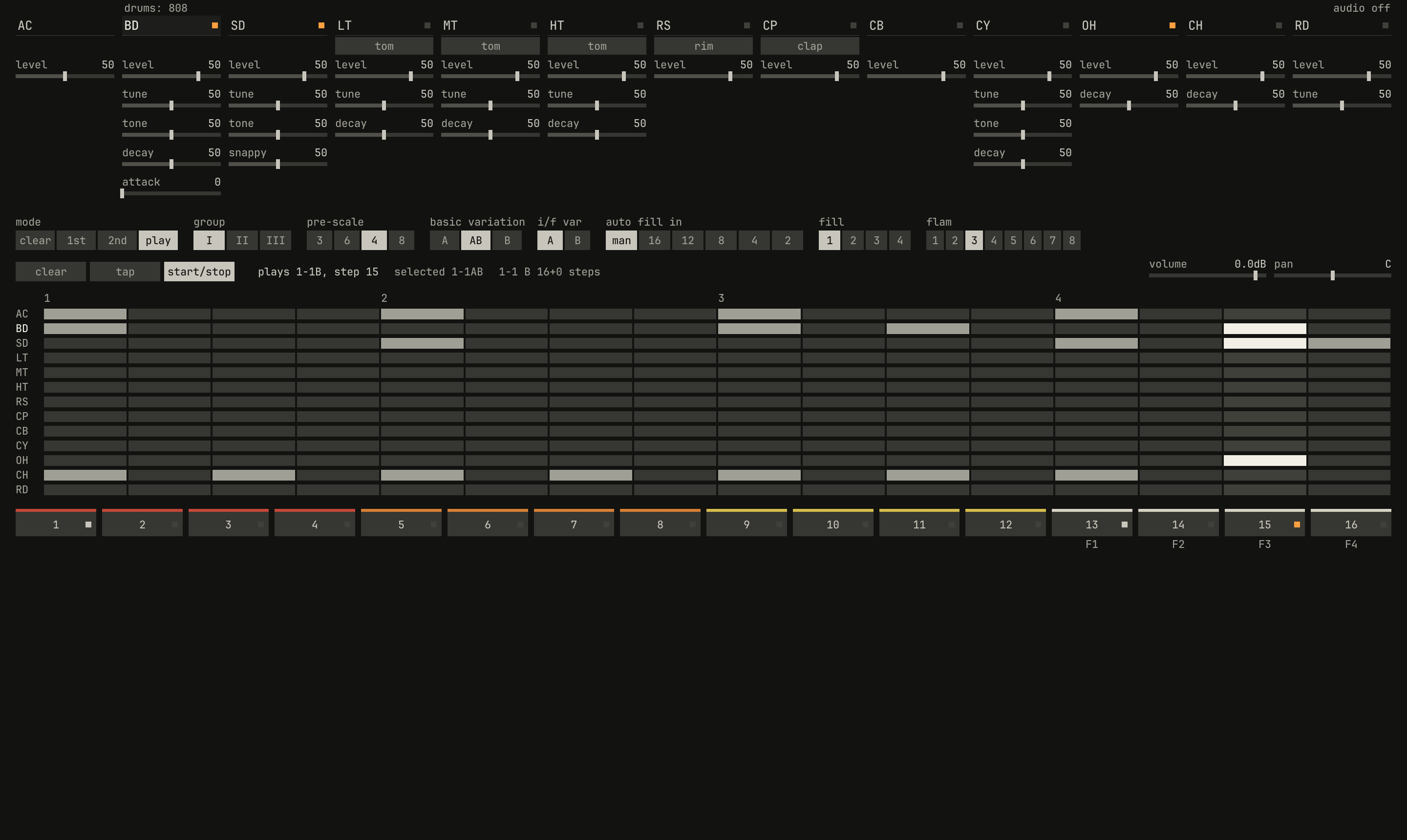
1-1, rock, playing AB: the picture is in the second bar, on step 15 of the B variation, where B has an open hi-hat that A doesn't. The line reads plays 1-1B, step 15, and selected 1-1AB.openzig build run-studio -- manual/drums/06-rhythms/ab --view device --play 1
renderzig build run-studio -- render manual/drums/06-rhythms/ab ab.wav
ab/song.json
{
  "tempo": 120,
  "end": "3",
  "devices": [{ "name": "808", "type": "drums", "state": { "program": "1-1AB" } }],
  "tracks": [
    { "name": "drums", "device": "808", "channel": 1, "role": "drums", "clips": [{ "at": "1", "length": "2.0.0", "pattern": "1-1AB" }] }
  ]
}
Each rhythm's two variations are two measures, written separately. The
basic variation switch picks which a basic rhythm plays: A, B, or
AB, A and B by turns. The 808's manual, page 14:
In contrast, when the switch is set at the AB position the TR-808 will play the A Mode and the B alternately, always beginning in the A Mode. This position is commonly used to program Rhythms that extend over two measures before repeating, a very common occurance in Rock music.
rock is written that way: its A is the beat, and its B the same beat with
a variation at the end, an extra kick, two snares, and an open hi-hat on
step 15. Played AB, it's a two-bar phrase. A switch to AB from B
goes on from where it is, "B to A, B, A", as the 808's does.
A rhythm in a variation is a program, and a pattern clip plays one by
its name: 1-1A, 1-1B, or 1-1AB, and a fill's 1-F2A or 1-F2B.
Fills have no AB, since they play once; the i/f var switch picks their
variation.
Steps and the pre-scale
0.0 / 4.8 s
peak -18.2 dBFS
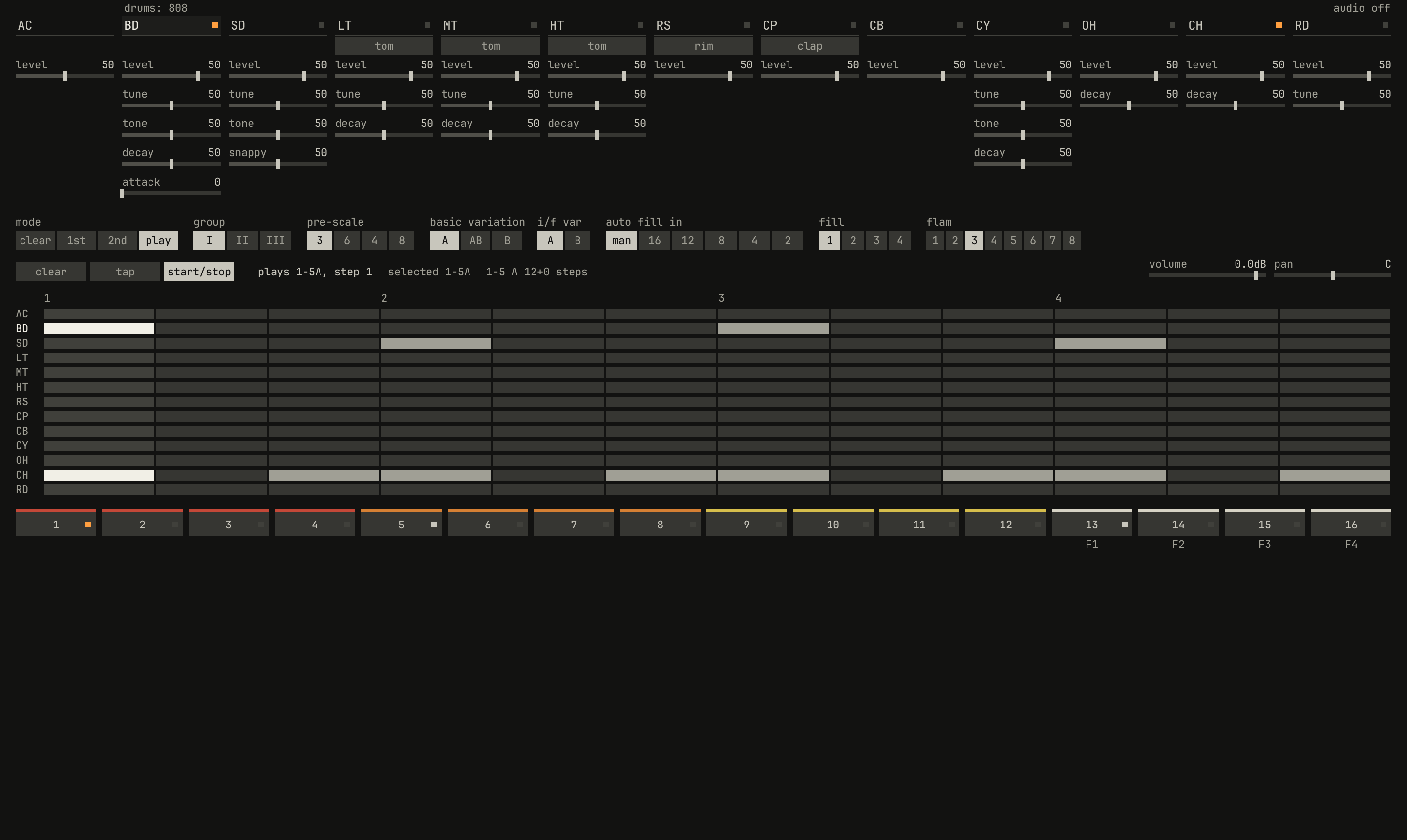
1-5, shuffle, at a pre-scale of 3: twelve steps, three a beat, numbered 1 to 4 over the grid. The hi-hat plays the first and third of each three, the shuffle's long-short.openzig build run-studio -- manual/drums/06-rhythms/shuffle --view device --play 1
renderzig build run-studio -- render manual/drums/06-rhythms/shuffle triplets.wav
shuffle/song.json
{
  "tempo": 100,
  "end": "3",
  "devices": [{ "name": "808", "type": "drums", "state": { "program": "1-5A" } }],
  "tracks": [
    { "name": "drums", "device": "808", "channel": 1, "role": "drums", "clips": [{ "at": "1", "length": "2.0.0", "pattern": "1-5A" }] }
  ]
}
A rhythm is a row of steps, each a hit or a rest for every voice. How long a step is, the rhythm's pre-scale says: how many steps make a beat. The 808's manual, page 3:
Each beat (or quarter note), can be divided into 3, 4, 6, 8, individual steps so that rhythms can be written incorporating as small a division as thirty-second notes.
The pre-scale selector reads 3, 6, 4, and 8, in the order of the
808's four positions:
| Position | Steps a beat | Each step is | At 120 BPM |
|---|---|---|---|
| 1 | 3 | a triplet 8th | 167 ms |
| 2 | 6 | a triplet 16th | 83 ms |
| 3 | 4 | a 16th | 125 ms |
| 4 | 8 | a 32nd | 62.5 ms |
A step is a whole number of the clock's pulses, 24 a beat, as MIDI's clock counts them: 8 at a pre-scale of 3, 4 at 6, 6 at 4, and 3 at 8. So every rhythm keeps time with every other, whatever its pre-scale. The 808's manual says which to choose (page 17): "The Pre Scale must always be chosen to match the minimum division of the note to be used in the Rhythm pattern." Triplets want 3 or 6; straight 16ths want 4; a 32nd roll wants 8.
0.0 / 4.8 s
peak -12.5 dBFS
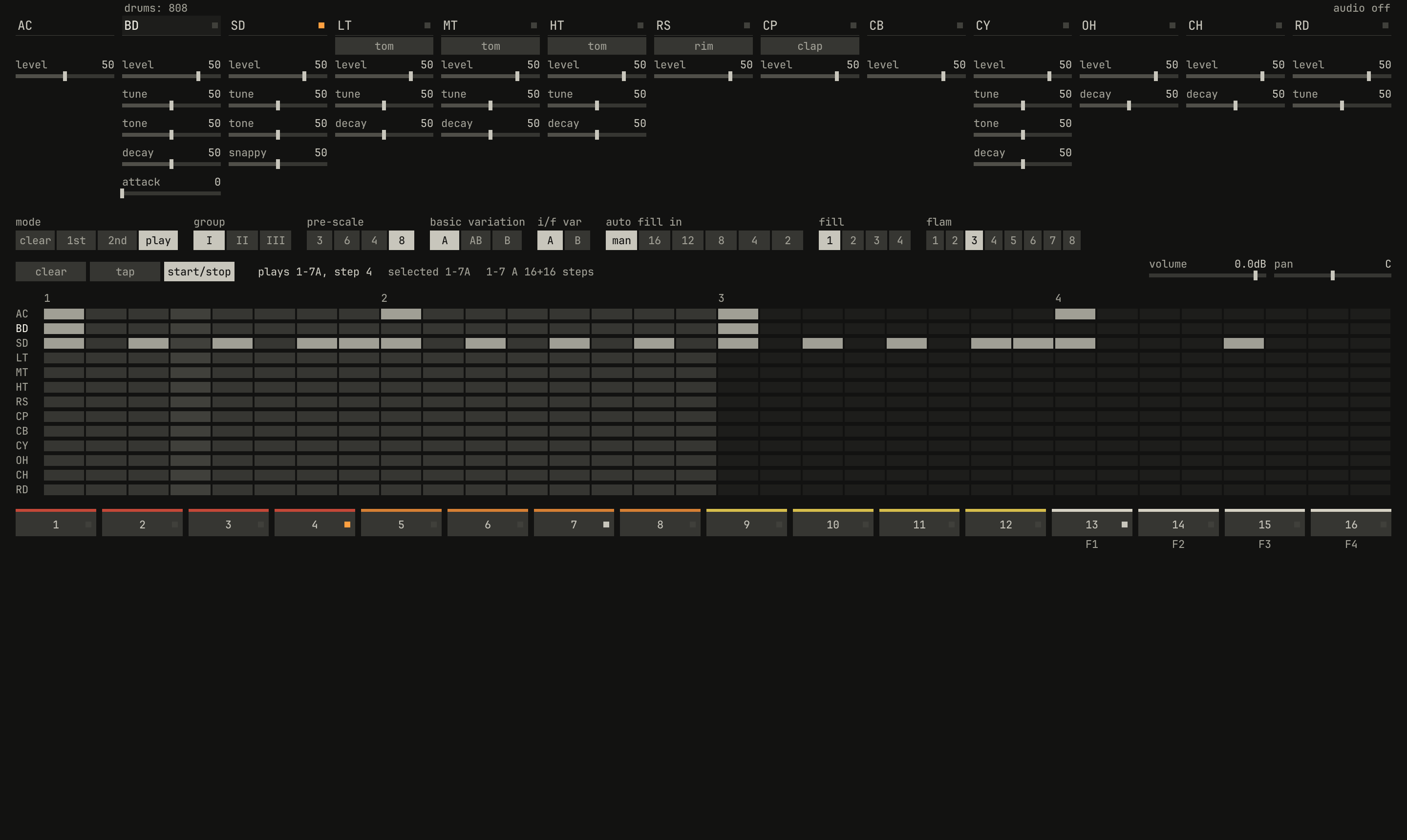
1-7, march, at a pre-scale of 8: 32 steps, 16 in each part, eight a beat. The snare's rolls are in 32nds; the grid's darker columns, on the right, are the 2nd part.openzig build run-studio -- manual/drums/06-rhythms/march --view device --play 1
renderzig build run-studio -- render manual/drums/06-rhythms/march thirty-seconds.wav
march/song.json
{
  "tempo": 100,
  "end": "3",
  "devices": [{ "name": "808", "type": "drums", "state": { "program": "1-7A" } }],
  "tracks": [
    { "name": "drums", "device": "808", "channel": 1, "role": "drums", "clips": [{ "at": "1", "length": "2.0.0", "pattern": "1-7A" }] }
  ]
}
The pre-scale is the rhythm's, shared by A and B, as on the 808 (page 18): "Setting a PRE SCALE and Step number in one mode will always make it the same in the other".
Two parts
A measure has two parts, the 1st and the 2nd, of up to 16 steps each,
so up to 32 steps in all. The 1st part plays, then the 2nd. Most rhythms use
the 1st part alone, 16 steps of 16ths; march, above, needs both for a bar
of 32nds, and the 2nd part's columns are drawn darker in the grid.
Each part has a last step, which sets how many of its steps play: the
1st from 1 to 16, the 2nd from 0, none, to 16. A fresh rhythm has 16 and 0,
as the 808's manual says a cleared one does (page 20): "At this point the
1st Part is set at 16 Steps and the 2nd Part is set at 0 Steps." The line
on the panel shows both, as 1-7 A 16+16 steps.
Steps past a part's last step stay in the rhythm: shorten a part, and its steps beyond the end stop playing, but they're kept, and play again when it's lengthened. The 909's manual has the last step for the same reason the 808 has two parts (page 23): "The TR-909 allows you to freely change the number of steps in a Rhythm Pattern, so even odd rhythm can be written."
A measure isn't always a bar

0.0 / 6.0 s
peak -18.5 dBFS
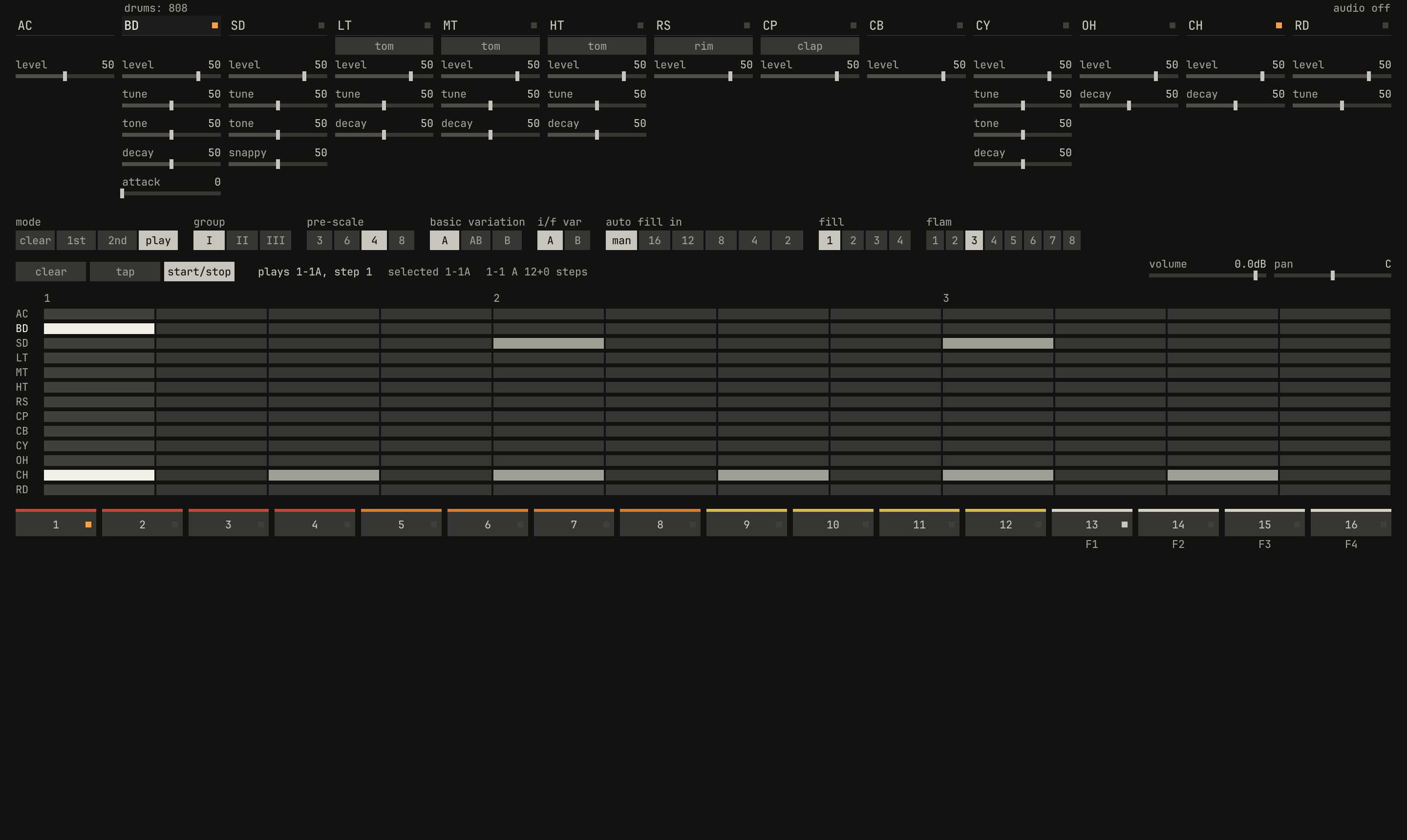
plays 1-1A, step 1, the start of its second measure.openzig build run-studio -- manual/drums/06-rhythms/waltz --view device --play 1
renderzig build run-studio -- render manual/drums/06-rhythms/waltz waltz.wav
waltz/song.json
{
  "tempo": 120,
  "end": "4",
  "devices": [{
    "name": "808", "type": "drums",
    "state": {
      "program": "1-1A",
      "rhythms": {
        "1-1": { "name": "waltz", "scale": 4, "steps": 12, "A": ["BD x...........", "SD ....x...x...", "CH x.x.x.x.x.x."] }
      }
    }
  }],
  "tracks": [
    { "name": "drums", "device": "808", "channel": 1, "role": "drums", "clips": [{ "at": "1", "length": "3.0.0", "pattern": "1-1A" }] }
  ]
}
The drum machine plays measure after measure of its rhythm, each as long as its steps make it: 16 steps of 16ths make four beats, a bar of the song. But twelve 16ths make three beats, and a measure of them is a bar of 3/4, while the studio's bars are 4/4. The song's waltz starts with the song, and its second measure starts on the fourth beat of bar 1, its third on the third beat of bar 2. Listen for the bass drum on each measure's first step, landing three beats apart, against the song's grid of four.
A measure is a bar only when its steps fill four beats: 16 at a pre-scale of 4, 12 at 3, 24 at 6, and 32 at 8. Others make odd meters, or, with the 2nd part, measures longer than a bar: 16 + 4 16ths is a bar of 5/4. It matters when a rhythm changes, which waits for the measure's end, not the bar's; chapter 8 shows it.
Accents and flams
0.0 / 4.0 s
peak -17.9 dBFS
openzig build run-studio -- manual/drums/06-rhythms/flam
renderzig build run-studio -- render manual/drums/06-rhythms/flam flam.wav
flam/song.json
{
  "tempo": 120,
  "end": "3",
  "devices": [{
    "name": "808", "type": "drums",
    "state": {
      "program": "1-1A",
      "voices": { "sd": { "level": 100, "snappy": 30 } },
      "rhythms": {
        "1-1": { "name": "wide flam", "scale": 4, "steps": 16, "flam": 8, "A": ["SD f.......x......."] },
        "1-2": { "name": "tight flam", "scale": 4, "steps": 16, "flam": 2, "A": ["SD f.......x......."] }
      }
    }
  }],
  "tracks": [
    {
      "name": "drums", "device": "808", "channel": 1, "role": "drums",
      "clips": [{ "at": "1", "length": "1.0.0", "pattern": "1-1A" }, { "at": "2", "length": "1.0.0", "pattern": "1-2A" }]
    }
  ]
}
A step holds, for each voice, a rest, a hit, or a hit with the voice's own
accent, and on the drums, a flam; and for the step, the AC row's
accent. Chapter 5 is the accents. A flam is the
drummer's two sticks landing not quite together, a grace note and then the
note: the 909 writes one on the bass drum, the snare, and the toms. Its
manual, page 25:
In the TR-909, the first sound of Flam is in time for a step, and the second one will follow. The position of the Tempo Knob does not affect the interval between them.
The flam selector sets the rhythm's interval, 1 to 8, as the 909's eight
do. The 909's manual doesn't give their lengths; the drum machine's run
from 4 to 32 milliseconds in steps of 4, and its first hit is at 60% of the
second's strength, 4.4 dB under it. Both are the drum machine's own choice.
At 8 the two hits are heard as two; at 1 or 2 they thicken one hit. The
grid draws a flam as an amber bar along the foot of its step.
Swing
The 909 has a shuffle, which delays every other 16th; the drum machine's is the song's swing, beside the tempo in the top bar, which bends every device's steps alike; the grid, in the studio's manual, teaches it. The drum machine's steps fall where the song's clock puts them, so at 66% the second 16th of each pair comes late, as the 909's shuffle had it.
Swing bends every step, not only 16ths. A rhythm at a pre-scale of 3, in triplets, comes out uneven under swing: at 66% and 120 BPM, its three steps in a beat land at 0, 193, and 360 milliseconds rather than 0, 167, and 333. A triplet rhythm is already swung, so play it at 50%.
A rhythm may say the swing it wants, as group 2's boom bap wants 58% and
two-step 56%. It's a hint: picked from a track's program list in the
arrange view, such a rhythm says so beside the pointer, as boom bap wants
58% swing: pick it again to set it, and a second pick sets the song's
swing. The drum machine itself never reads it.
The factory rhythms
A fresh drum machine holds these, with their lengths, their pre-scales, and the swing each wants:
| Rhythm | Name | Steps | Steps a beat | Swing |
|---|---|---|---|---|
1-1 | rock | 16 | 4 | any |
1-2 | rock 2 | 16 | 4 | any |
1-3 | disco | 16 | 4 | any |
1-4 | backbeat | 16 | 4 | any |
1-5 | shuffle | 12 | 3 | any |
1-6 | bossa | 16 | 4 | any |
1-7 | march | 32 | 8 | any |
1-12 | rhythm 12 | 16 | 4 | any |
1-F1 | snare fill | 16 | 4 | any |
1-F2 | tom fill | 16 | 4 | any |
1-F3 | triplet fill | 24 | 6 | any |
1-F4 | crash | 16 | 4 | any |
2-1 | house | 16 | 4 | any |
2-2 | deep house | 16 | 4 | any |
2-3 | techno | 16 | 4 | any |
2-4 | electro | 16 | 4 | any |
2-5 | boom bap | 16 | 4 | 58% |
2-6 | breakbeat | 16 | 4 | any |
2-7 | two-step | 16 | 4 | 56% |
2-8 | dembow | 16 | 4 | any |
2-9 | trap | 32 | 8 | any |
2-10 | funk | 16 | 4 | any |
2-11 | half-time | 16 | 4 | any |
2-12 | synth-pop | 16 | 4 | any |
2-F1 | snare roll | 32 | 8 | any |
2-F2 | tom run | 16 | 4 | any |
2-F3 | build | 16 | 4 | any |
2-F4 | stop | 16 | 4 | any |
Group 1 is the 808's kind of rhythm, as a new 808 held: two rocks, disco,
a backbeat with claps, a shuffle in triplets, a bossa on the rim shot, a
march in 32nds, and rhythm 12, every voice at once, after the 808's own
rhythm 12. Its manual, page 13: "This Rhythm is used for checking purposes
only, and to help you become familiar with the different sounds produced
by the TR-808." Its fills are a snare fill, a tom fill, a triplet fill, and
a crash. Group 2 holds twelve beats by style to start a song from, each
with an A and a B, and four fills for them: a snare roll, a tom run, a
build, and a stop. Places 1-8 to 1-11 and all of group 3 are empty.